
Reviewed · BUKHARA TOURS
Bukhara Full Day Old City Private Tour
Bukhara is best understood on foot, one domed market, tiled madrasa, and old courtyard at a time. This private tour brings the city’s major sights into one long walk, with local guides such as Shakhnoza, Maksad, Sunny, and Guzel explaining the legends, faiths, rulers, and daily life behind the monuments.
I like the private format, which lets you ask questions and linger where your interest is strongest. I also like the wide sweep of the route: you see the famous Kalon Minaret and Ark fortress, but also the quieter Bukhara Synagogue, Maghak-i Attari Mosque, and the trading domes where the Silk Road still feels close.
The main consideration is stamina. The tour is listed at 5 to 7 hours, and much of it is on foot. Lunch is not included, so you should ask your guide to plan a food break rather than assume one is built into the day. Also confirm the return to your hotel at the end.
Key points to know before you book
- Fourteen major stops in one private day: The route covers Bukhara’s best-known monuments, religious buildings, markets, and public squares.
- A walking tour with real flexibility: Guides can adjust the pace, allow shopping or coffee breaks, and sometimes add sights when time and interest allow.
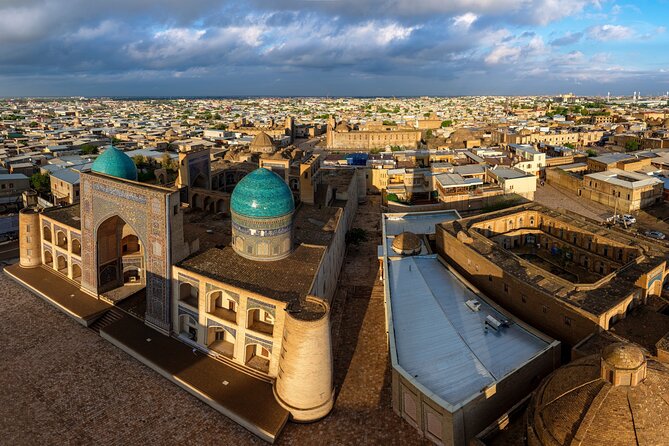
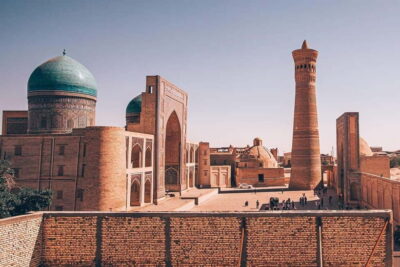
- The Kalon complex is the visual center: The minaret, mosque, and Mir-i-Arab Madrasa form the most memorable architectural group on the route.
- Local guides make the difference: Shakhnoza is praised for her command of Bukhara, while Maksad, Sunny, Guzel, Guli, Malika, Bekhruz, and Sitora are also named as guides who bring personal knowledge and warmth.
- Budget for photo fees: Museums may charge $1 per site for photography or video, paid directly on location.
- Good value for a private introduction: At $85 per person, the price includes the licensed guide, taxes, and monument admission, with group discounts available.
Why this long walk works in Bukhara
Bukhara is not a city you understand by checking off one grand sight. Its character comes from the links between places: a mosque beside a market, a madrasa facing a pool, and a fortress that once controlled the city around it.
This tour gives you that connection. You move through the old center rather than viewing monuments as isolated museum pieces. Your guide can explain how religious schools, trading buildings, courtyards, and public gathering places fit together.
The private setup matters here. You can ask about architecture, Islam, Soviet-era changes, Jewish life, local food, or the stories of Uzbek rulers without waiting for a group to move along. Guides have also adjusted the day for shopping, coffee, lunch, and personal interests.
At $85 per person, this is not the cheapest way to walk around Bukhara. But it includes all entrance tickets and taxes, and a private guide can save you from guessing which doorway, courtyard, or museum room matters. For two or more people, group discounts may improve the value.
A few more Bukhara days to weigh up
- Best of Bukhara: All Day Private Old Town Tour
★ 5.0 · 66 reviews - Best of Bukhara: All Day Private Old Town Tour
★ 4.9 · 62 reviews - Legends of Bukhara: Exclusive Full-Day Tour
★ 5.0 · 4 reviews
The Kalon Minaret and Mir-i-Arab Madrasa
The Great Minaret of the Kalon is the natural opening act. Its brickwork and height make it one of Bukhara’s clearest symbols, and the 30-minute visit gives you time to look closely rather than simply stop for a photograph.
Your guide can help you separate fact from legend. Bukhara is full of stories connected to rulers, scholars, religion, and conquest, and this is one of the places where those stories give the monument its power.
Next comes Mir-i-Arab Madrasa, another 30-minute stop. Its tiled patterns and large hall face the same courtyard area as the mosque, creating a compact architectural lesson in how Bukhara’s religious buildings were arranged.
Admission is included at both places. Keep in mind that photo and video charges at museums are separate, listed at $1 per site. If you like taking pictures inside historic buildings, carry some small cash for these fees.
Chor Minor, a small building with a big personality
Chor Minor is a useful change of scale. Instead of the broad drama of the Kalon complex, you see a historic gatehouse linked to a madrasa that no longer survives.
The four-tower form makes it instantly recognizable. The visit lasts about 30 minutes, enough to hear the building’s story and appreciate its unusual shape without making the morning feel like one enormous monument parade.
This stop also shows why a guide helps. A person walking alone might take a quick photo and move on. With an explanation of its original role as a madrasa gatehouse, the building becomes part of Bukhara’s vanished urban plan.
The Ark fortress takes you into Bukhara’s power center
Allow an hour for the Ark of Bukhara, the biggest single stop on the route. This massive fortress was first built and occupied around the fifth century AD, and its raised walls and enclosed spaces give you a strong sense of political power.
The Ark is not just an old wall. It represents the ruling center of Bukhara, where dynasties governed, officials worked, and the city’s fate was decided. A good guide can turn the visit from a sequence of rooms into a story about authority and survival.
An hour may feel short if you want to examine every display. Still, it is enough for a focused introduction, especially because the rest of the day includes many more sites. Wear comfortable shoes and expect the tour to keep moving after this visit.
Same city, a completely different day out:
- Bukhara: Walking Tour with a Small Group
★ 4.9 · 260 reviews - From Bukhara: 2-Day Desert Yurt Camp Tour
★ 4.5 · 57 reviews - City Tour Around Bukhara
★ 5.0 · 55 reviews - Bukhara: Historic Center Guided Sightseeing Tour
★ 4.8 · 44 reviews
Poi Kalyan brings the morning’s main monuments together
The Poi Kalyan complex includes the Kalyan Mosque, Kalyan Minaret, and Mir-i-Arab Madrasa. The tour lists about 20 minutes here, separate from the earlier minaret and madrasa visits.
That timing suggests a quick architectural overview rather than a long independent exploration. It is useful because your guide can connect the three buildings and explain how the group functions as one of Bukhara’s central religious spaces.
If the Kalon complex is the sight you most want to study, tell your guide early. On a private tour, you have a better chance of shaping the available time around your priorities, though the full route is ambitious.
Lyab-i-Hauz and Nodir Devon Begi
Lyab-i-Hauz is one of the most pleasant pauses in the old city. The ensemble is formed by the Kukeldash Madrasa, a khanaka, and Nodir Divan-begi. The name refers to the pool at the heart of the complex, which gives the area a different feel from the fortress and monumental mosque.
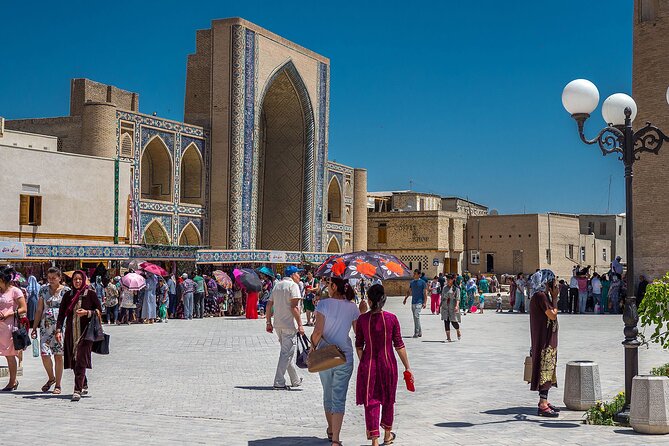
You have about 30 minutes here, followed by another 30 minutes at Nodir Devon Begi Madrasasi. Its ornate, mosaic-covered gate and courtyard shops add a more social, active side to the old city.
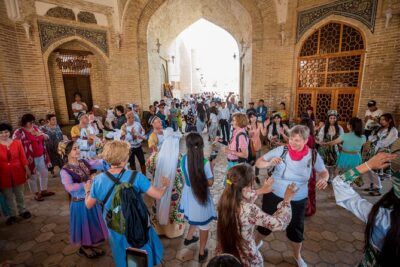
You might find folk dance shows in the courtyard, and the shops make this a sensible place to browse local crafts. Shopping time can be adjusted, as one guide did for a more relaxed day, but remember that extra browsing can shorten time at later monuments.
The Monument to Hodja Nasreddin is nearby and takes about 15 minutes. The bronze figure brings humor into the route. Nasreddin is associated with clever stories and comic wisdom, and the statue adds a light moment beside the more solemn religious buildings.
Bolo Hauz Mosque and the view across from the Ark
Bolo Hauz Mosque receives a shorter 15-minute visit. Built in 1712 opposite the Ark in the Registan district, it is a useful counterpoint to the fortress.
The mosque is included within Bukhara’s UNESCO-listed historic area, and its position helps you read the city spatially. Instead of viewing the Ark as a separate attraction, you see how religious and political buildings faced one another in the old center.
Fifteen minutes will not allow a slow study of every detail. Treat this as a focused stop, and use your guide’s explanation to understand why the mosque belongs on a city highlights route.
The trading domes preserve Bukhara’s commercial side
The four remaining trading domes sit along a north-to-south route through the old city. The tour allows an hour here, making this one of the longer stops.
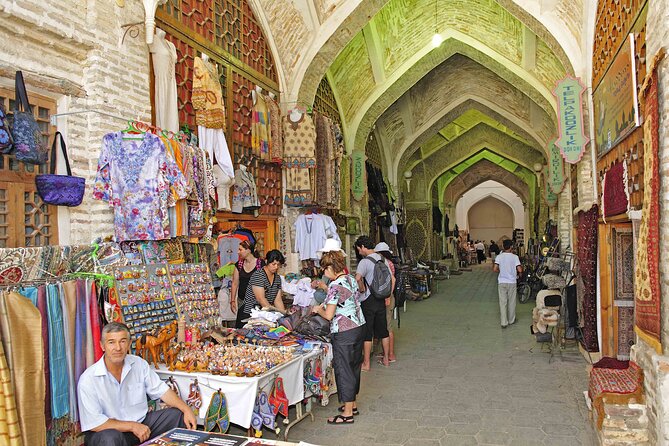
This is where Bukhara feels less like a collection of royal and religious monuments and more like a working commercial town. The domes once sheltered trade, and today they hold shops selling local arts, crafts, and products.
I would save some energy and curiosity for this part of the walk. You can ask your guide about what is genuinely local, compare prices, and decide what deserves space in your luggage. Since shopping time is flexible on a private tour, be clear if you want to browse rather than rush onward.
The domes are also practical landmarks. Their north-to-south arrangement helps you understand the old city’s circulation, with important sights linked by routes that still invite walking.
Two Ulughbek-era madrasas, two different impressions
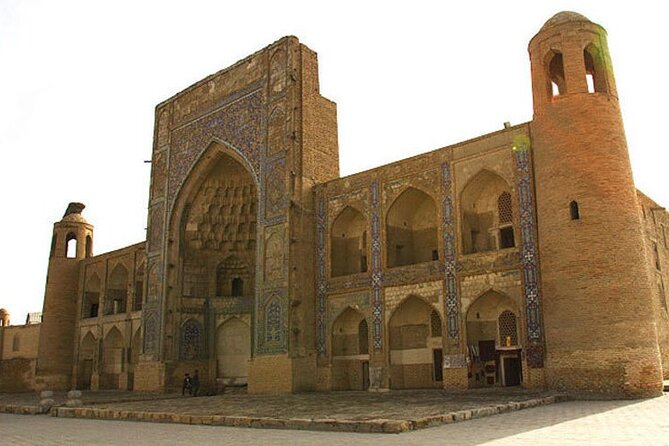
Abdulaziz-Khan Madrasa receives about 20 minutes. It is associated with the scholarly and artistic traditions encouraged by Ulughbek, whose first madrasa in Bukhara was built in 1417.
Ulugbek Madrasah, completed in 1420, also takes about 20 minutes. Its exterior tiles, fluted dome, stained windows, and old tombs give you several details to look for during a short visit.
Seeing both buildings together is valuable. You can compare their decoration, layout, and age rather than hearing about them as unrelated stops. Your guide can also explain Ulughbek’s role as a ruler, scholar, and supporter of learning.
The schedule is tight, so ask questions as you go. If you want a slow architectural study, these are places where a private guide can help you decide which details deserve your attention.
Maghak-i Attari Mosque and Bukhara’s layered past
Maghak-i Attari Mosque is scheduled for about 20 minutes and forms part of the Lyab-i-Hauz historic religious complex.
Its importance lies partly in the layers of Bukhara beneath the present-day city. The old center has passed through many dynasties and occupations, and a local guide can explain how religious buildings fit into that long sequence without turning the visit into a dry list of dates.
This stop also helps balance the day. You have seen large, highly photographed monuments, but smaller buildings often reveal how worship and neighborhood life worked at street level.
The Bukhara Synagogue adds an important voice
The final listed stop is Bukhara Synagogue, with about 30 minutes. The route’s inclusion of a Jewish place of worship is one of its strongest features.
Bukhara Jews are spread across the world today and made important contributions to Central Asian and Silk Road civilization. That story broadens your view of the city beyond Islamic architecture and ruling dynasties.
The synagogue visit is free, as is the Monument to Hodja Nasreddin and the trading domes. Other monument admissions are included, so the day does not require constant ticket purchases. You should still allow for the separate museum photo charges if you plan to take pictures indoors.
Guides who shape the day
The experience depends heavily on the person assigned to your group. Shakhnoza is repeatedly praised for her fluent explanations, flexibility, patience, and pride in the city where she was born and lives. She has adjusted routes, suggested lunch, shared places to explore the next day, and taken photographs for a solo visitor.
Maksad is described as professional, friendly, and able to make Bukhara’s landmarks easy to understand. Sunny has helped with practical matters such as getting cash and has been especially generous with her time. Guzel is noted for arriving early and allowing coffee and shopping breaks.
Other named guides include Bekhruz, Guli, Sitora, and Malika. The common thread is not a scripted performance. It is the chance to hear about Bukhara from someone connected to the city and able to answer questions about culture, social life, religion, architecture, and local stories.
Guide quality can vary from person to person, as it can on any tour. One guide was described as friendly with basic historical information, while another ended the day in a square rather than returning to the hotel as expected. Confirm the end plan at the start, especially if you need to collect luggage or catch transport.
Timing, food, and practical comfort
The tour lasts roughly 5 to 7 hours, although some groups have completed the main route in about five hours and one account describes seeing the important points in three. The difference will depend on walking speed, questions, shopping, breaks, and how long you spend inside each monument.
It is an all-foot route according to the tour details and direct descriptions of the experience. That makes sense in Bukhara’s old center, where many sights are close together, but it also means you should wear comfortable shoes and plan for a full day of standing and walking.
Lunch is not included. This is easy to manage if you tell the guide you want a proper meal break. Guides have recommended lunch and taken people for plov after the tour, but you should treat that as something to request, not a guaranteed part of the package.
Pickup is offered, and the stated meeting point is Hotel Malika-Bukhara on Gavkushon Road 25. The planned end is back at the meeting point. Since one account describes an unexpected finish in a square, confirm the exact return arrangement before setting off.
The tour has a 98 percent recommendation rate and a 4.9 rating from 46 reviews. Those figures point to strong satisfaction, especially with the guides, but they should not make you ignore the walking demands or the need to organize lunch.
Who will get the most from this tour
I would choose this tour for a first day in Bukhara, especially if you want the major sights explained in a sensible order. It suits couples, families, and small groups who prefer to stop and ask questions instead of following a fixed public group.
It is also a good fit if you care about history, architecture, archaeology, anthropology, or local religion. Sitora, for example, has been praised for explaining those subjects along with old stories tied to Persia.
Solo visitors can benefit from the private format too. You can move at your own pace, ask for photos, and request help with practical matters such as cash or lunch.
I would think twice if you dislike long walking days or want a slow, single-neighborhood tour. Fourteen stops is a lot. The price buys breadth, not unlimited time at every monument.
Should you book the Bukhara Old City tour?
Book it if you want an efficient, personal introduction to Bukhara and value a local guide who can connect monuments with living culture. The strongest reasons are the private pacing, included entrance fees, broad route, and chance to request help with lunch, shopping, or extra sights.
Before booking, ask about the guide’s language, the expected start and finish time, lunch planning, and the hotel return. If your group includes people with limited walking stamina, ask how the route can be shortened.
At $85 per person, it is a sound choice for a full private day, particularly with a group discount. You will see a great deal of Bukhara in one outing, then have the next day to revisit the places that caught your attention.
FAQ
How long does the Bukhara Old City tour last?
The tour lasts approximately 5 to 7 hours. Some groups have completed the main sights in about five hours, depending on pace, breaks, questions, and shopping time.
What is the price of the tour?
The listed price is $85 per person. Group discounts are available.
Is this a private tour?
Yes. Only your group participates in the activity.
Is hotel pickup available?
Pickup is offered. The stated starting point is Hotel Malika-Bukhara on Gavkushon Road 25 in Bukhara.
Where does the tour finish?
The planned end is back at the meeting point. Confirm the return details with your guide at the beginning of the tour.
Are entrance tickets included?
Yes. Entrance tickets to all listed monuments, along with all fees and taxes, are included.
Do I need to pay extra for photos?
Museums may charge $1 per site for photo or video use. This fee is paid directly to the museums and is not included in the tour price.
Is lunch included?
No. Lunch is not included. Ask your guide to schedule a meal break if you want one during the day.
Can I cancel for a full refund?
Yes, if you cancel at least 24 hours before the experience start time. Cancellations or changes made less than 24 hours in advance are not accepted for a refund.
Just added around Bukhara
- Bukhara: City Highlights Guided Tour with Pickup★ 5.0 · 3 reviews
- Full-Day Private Guided Tour to Islamic 7 Saints of Bukhara★ 4.5 · 3 reviews
- Uzbekistan 8 Days Private Guided Tour★ 4.6 · 3 reviews
- 9 Days Private Guided Tour to Uzbekistan★ 5.0 · 3 reviews
- Bukhara Walking Tour★ 5.0 · 4 reviews
- Legends of Bukhara: Exclusive Full-Day Tour★ 5.0 · 4 reviews
- 2 Day Ukhum Hiking Tour from Bukhara★ 5.0 · 4 reviews
- Bukhara day tour★ 4.0 · 4 reviews
Bukhara Tours, compared.
Bukhara: Historic Center Guided Sightseeing Tour
Read our review →
All You Need To Know About Bukhara. A Walk In The Town
Read our review →
Browse the lists this tour appears in