
Reviewed · GUIDED TOURS IN BUKHARA
Bukhara: Historic Center Guided Sightseeing Tour
Bukhara’s old center is best understood on foot, where blue-tiled domes, shaded trading passages, royal walls, mosques, and old water pools appear within a compact historic area. This five-hour private tour brings the main sights together, from the towering Poi Kalyan complex to the small, atmospheric Magok-i Attari Mosque and the fifth-century Ark Citadel.
I like the private format, which gives you room to ask questions and adjust the pace. I also like the focus on stories rather than quick photo stops. Guides such as Kamilla, Shakhlo, Nilufar, Lilly, and Charos have been praised for clear explanations, patience, local suggestions, and the ability to shape the walk around your interests.
The main catch is simple: transport is not included. The route is built around walking, and entrance fees, meals, and drinks cost extra. The information also says the activity is wheelchair accessible but later says it is not suitable for wheelchair users, so anyone with mobility concerns should confirm the route before booking.
Key points at a glance
- Poi Kalyan gives you Bukhara’s grand opening scene: a major mosque, madrasa, and minaret complex in one historic square.
- The tour connects big monuments with smaller places: Magok-i Attari, Tim Abdullah Khan, and the Samanid Mausoleum add texture beyond the famous sights.
- A private guide makes the difference: you can ask about a particular era, pause for photos, or spend more time shopping.
- Expect a serious walking day: comfortable shoes matter, and there is no included car with driver.
- The price is $47 per person: fair for a private five-hour guide, but you need to budget separately for entrances and lunch.
- Guide quality is a strong point: English and Russian are available, with praised guides including Kamilla, Shakhlo, Nilufar, Lilly, and Charos.
Why Bukhara works so well on foot
Bukhara’s historic center is listed as a UNESCO World Heritage site, but you do not need a lecture on heritage status to see why the designation matters. The city places layers of religious, royal, commercial, and funerary architecture close together.
You begin at your hotel in Bukhara, meeting the guide in the lobby about five minutes before the start. From there, the tour moves through the old center on foot. Since the experience is private, you are not tied to the interests of a large group, and that matters in a city where the difference between a quick look and a useful explanation is often just one good question.
The route lasts about five hours, although the schedule describes four to five hours in places. That is enough time for the main sights, but not enough for a slow museum visit at every stop. You will want to balance photography, shopping, and questions with the walking time.
More Guided Tours in Bukhara
- Bukhara Historical City Highlights Guided Walking Tour
★ 4.5 · 16 reviews - Bukhara: Private Guided Walking Tour with Hotel Pickup
★ 5.0 · 11 reviews - 2 – Days Guided Tour of Samarkand and Bukhara from Tashkent
★ 5.0 · 5 reviews
Poi Kalyan: Bukhara’s grand first impression
Poi Kalyan is the natural star of the morning. The architectural complex gives you the kind of monumental setting that makes Bukhara feel larger than its quiet lanes suggest.
Your guide explains the buildings and their place in the city’s religious life, then gives you time to look closely. The complex is especially useful as an introduction because it shows the scale and decoration of Bukhara’s Islamic architecture before you move to more intimate sites.
The scheduled visit lasts about an hour. That allows time for a guided explanation and a proper walk around the area. Ask your guide about the construction, the role of the religious schools, and how the complex fits with the rest of the old city.
Do not expect the full hour to be a nonstop lecture. The best guides, including Kamilla and Shakhlo according to the feedback attached to this activity, leave room for questions and independent looking. That approach suits Bukhara. Tiles, brickwork, carved details, and changing angles reward your attention.
Ulug Beg and Abdulaziz Khan madrasas
The tour also includes the historic madrasas of Ulug Beg and Abdulaziz Khan. These schools introduce an important part of Bukhara’s intellectual and religious past.
A guide can help you separate the two buildings rather than treating them as another pair of decorated facades. Ulug Beg was connected with the celebrated Timurid ruler and scholar Ulug Beg, while Abdulaziz Khan represents a later phase of Bukhara’s architectural tradition. The value here is comparison: look at the entrances, decorative treatment, proportions, and the way each building presents itself to the street.
This is where a private tour earns its keep. If you are interested in science, education, religious study, or medieval Central Asian rulers, say so early. Kamilla was specifically praised for preparing extra material when a visitor wanted to focus on a particular period. That sort of preparation cannot be promised with every guide, but it is worth asking for when you book.
Magok-i Attari and the older layers of the city
Magok-i Attari Mosque is one of the more atmospheric stops because it feels different from the large ceremonial complexes. The name is often associated with a lower or sunken position, and the building’s setting gives it a more enclosed character.
The stop is scheduled for about an hour, including guided sightseeing and walking. Here, you will benefit from listening carefully to how your guide explains the site’s age, religious role, and place in Bukhara’s changing urban fabric.
The attraction is not only the decoration. It is the sense that the city was rebuilt, adapted, and used across long periods. Your guide can point out details that are easy to miss if you simply walk past the entrance.
For me, this is one of the reasons to choose a guided walk instead of relying only on a map. A map tells you where the mosque is. A local guide can explain why it matters and connect it to Bukhara’s many mosques, tombs, and religious institutions.
More historic sites near Bukhara:
- Bukhara in a Day History, Culture, and Local Insight Private Tour
★ 5.0 · 4 reviews - Samarkand: Historical Monuments Guided Walking Tour
★ 4.8 · 446 reviews - Khiva: Historical City Highlights Guided Walking Tour
★ 4.8 · 156 reviews - Samarkand: Historical City Highlights Guided Walking Tour
★ 4.8 · 153 reviews
Tim Abdullah Khan: shopping inside a 1577 trading dome
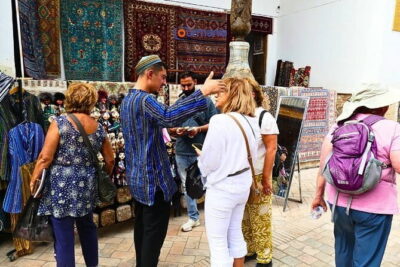
Tim Abdullah Khan is a covered bazaar dating from 1577, and the stop lasts about 50 minutes. It is a welcome change of pace after the religious buildings.
The covered dome was designed for trade, and you can use the time for window shopping or actual purchases. One visitor specifically appreciated having enough time for both. That is useful advice: do not rush through this stop, but also do not assume every minute must be spent buying something.
Shopping is optional, and the tour does not say that purchases are included. Use this time to examine the goods, compare prices, and ask your guide for help if you need context. A private guide can also help you avoid losing time if you are not interested in shopping.
The covered setting offers some relief from the sun, though the overall tour still involves outdoor walking. If you are visiting in a hot season, keep water with you and use the breaks sensibly.
Lyabi Khauz and Bukhara’s social center
Lyabi Khauz is built around a historic pool and is one of the city’s most recognizable gathering places. The tour allows about an hour here, with guided sightseeing.
This is a good spot to notice that Bukhara is not only a collection of monuments. The pool, surrounding buildings, shade, and public setting help you picture how people met, rested, traded news, and moved through the city.
I would ask your guide to explain the ensemble as a whole rather than focusing on a single facade. The power of Lyabi Khauz comes from the relationship between the water, the surrounding architecture, and the public space.
Breaks at coffee shops or chai khanas were especially appreciated during one tour, helping keep the pace comfortable. These pauses are not listed as a guaranteed inclusion, so treat them as something your guide may arrange rather than part of the formal package. Lunch is also not included.
The Ark Citadel and Bolo Haouz Mosque
The Ark Citadel is the most powerful reminder that Bukhara was a seat of government as well as a religious center. The former royal residence is dated to the fifth century, and its walls give the visit a very different mood from the open courtyards and trading domes.
The guided stop lasts about an hour. The guide’s role is important here because the Ark contains a great deal of history within one imposing site. You will want to understand how the citadel functioned as a royal residence and administrative center, not just photograph the entrance.
Entrance tickets are not included, so plan to pay on the spot. The exact ticket cost is not provided, and it may be wise to carry local currency or ask your guide what payment is accepted that day.
Bolo Haouz Mosque follows as a shorter visit of about 30 minutes. Its elegant 17th-century design gives you another view of Bukhara’s mosque architecture. The shorter time works well here: you can see the exterior and key features without turning the day into a checklist of long explanations.
The Samanid Mausoleum and Chashma Ayub
The Samanid Mausoleum is one of the tour’s most important stops. Its restrained brick design differs sharply from the bright tilework associated with Poi Kalyan and other major monuments.
That contrast is valuable. Bukhara’s architecture is not one single visual style, and the mausoleum helps you see the skill in pattern, structure, and brick detail without relying on color. Your guide can also place the building within the wider story of the Samanid period.
Chashma Ayub Mausoleum is another of Bukhara’s revered tombs. It is connected with Islamic traditions and adds a quieter, more reflective note near the end of the route.
The information gives the Samanid Mausoleum its own scheduled hour, while Chashma Ayub appears in the broader description of the tour. Your exact time at each site can vary, especially if you spend longer at the Ark, shop at Tim Abdullah Khan, or stop for lunch.
What the guides add
The strongest part of this experience is the guide. The monuments are worth seeing on their own, but Bukhara can blur into a series of domes and courtyards without someone to connect the pieces.
Several named guides have received especially strong praise. Kamilla is described as enthusiastic, clear, flexible, and willing to research a visitor’s preferred historical period. Shakhlo is noted for professional but friendly explanations, while Shakhnoza is praised for patience and for allowing enough time to explore each attraction without feeling rushed.
Nilufar, also called Lola, has been appreciated for detailed stories and a helpful restaurant recommendation. Lilly has been described as bringing Bukhara’s culture to life through stories about craftsmanship, important figures, and the links between Uzbek and outside cultures. Charos and Rizo are also noted for creating a personal, well-paced experience.
You cannot assume you will receive a particular guide unless the operator confirms it. Still, these details tell you what to request: clear historical explanations, time for photographs, a flexible pace, and advice on food or tea.
Walking, transport, and comfort
This is a walking tour, not a vehicle tour. The provider does not include a car or driver, so you should wear comfortable shoes and be ready to cover uneven streets and extended outdoor distances.
The tour information creates an accessibility conflict. One section says the activity is wheelchair accessible, while another says it is not suitable for wheelchair users. Do not rely on the general accessibility label. Contact the provider before booking and ask about the actual surfaces, entrances, toilet access, and whether a vehicle can be arranged.
The group is private, which is helpful for families and couples who want to stop often. It also makes the $47 price easier to assess. For one person, the cost is less of a bargain than for two or more people sharing a private guide, but the value improves if you want personal attention and a flexible route.
Is $47 a fair price?
At $47 per person, this tour offers a solid package for a private five-hour guide, especially if you want the main old-city sights explained in English or Russian.
The price does not cover entrance tickets, lunch, dinner, accommodation, flights, train tickets, or transport during the tour. Those extras do not make the activity poor value, but you should add them to your day budget before comparing it with a larger group tour.
The real question is how much you value interpretation. If you are happy to read signs, follow a map, and visit places independently, you may prefer a self-guided walk. If you want the monuments linked through stories, need help with pacing, or are curious about a particular era, a private guide can justify the cost.
Free cancellation up to 24 hours before the start and reserve-now, pay-later booking also reduce the risk of committing too early. Starting times depend on availability, so check the time when booking.
Who should book this Bukhara tour?
You should consider it if you have one day in Bukhara and want the major sights covered without spending hours working out the route. It is also a good choice for first-time visitors who want context before returning to favorite sites alone.
Families may appreciate the private format and the ability to request breaks. Couples and solo visitors can benefit from the guide’s local suggestions, especially for food, photographs, and shopping.
History-minded visitors should ask in advance about a preferred period or subject. The guide may be able to prepare extra material, as Kamilla did for one booking, but this should be treated as a request rather than a guaranteed service.
You may want a different arrangement if you dislike walking, require fully step-free access, or want all admission tickets and meals bundled into one price.
Final verdict
I would book this tour if I wanted a clear introduction to Bukhara’s old center with a private guide and enough time to ask questions. The route covers the city’s essential mix: grand religious architecture at Poi Kalyan, trading history at Tim Abdullah Khan, royal power at the Ark, public life at Lyabi Khauz, and quiet memorial buildings such as the Samanid Mausoleum and Chashma Ayub.
Book it with three checks in mind: confirm the guide language, ask about transportation if you cannot walk comfortably, and budget for entrances and lunch. For most visitors who want more than a string of photographs, $47 is a reasonable price for five hours of personal guidance.
FAQ
How long does the Bukhara sightseeing tour last?
The activity is advertised as five hours, while the detailed description gives a four to five-hour range. Starting times depend on availability.
Where does the tour begin?
You meet the local guide in your Bukhara hotel lobby about five minutes before the sightseeing begins.
Is hotel pickup included?
Yes. Pickup from your hotel in Bukhara is included.
Is transportation by car included?
No. The tour does not include a car or driver. You should wear comfortable shoes or contact the provider to arrange transportation.
Which languages are available?
The live guide service is available in English and Russian.
Is this a private tour?
Yes. The activity is arranged for a private group.
Are entrance tickets included?
No. Entrance tickets are paid separately on the spot.
Is lunch included?
No. Lunch and dinner are not included.
What should I bring?
Bring comfortable shoes because the tour involves walking through the historic center.
Are drones allowed?
No. Drones are not allowed during the activity.
Just added around Bukhara
- Bukhara: City Highlights Guided Tour with Pickup★ 5.0 · 3 reviews
- Full-Day Private Guided Tour to Islamic 7 Saints of Bukhara★ 4.5 · 3 reviews
- Uzbekistan 8 Days Private Guided Tour★ 4.6 · 3 reviews
- 9 Days Private Guided Tour to Uzbekistan★ 5.0 · 3 reviews
- Legends of Bukhara: Exclusive Full-Day Tour★ 5.0 · 4 reviews
- Bukhara Walking Tour★ 5.0 · 4 reviews
- 2 Day Ukhum Hiking Tour from Bukhara★ 5.0 · 4 reviews
- Bukhara day tour★ 4.0 · 4 reviews
Guided Tours in Bukhara, compared.
Bukhara Historical City Highlights Guided Walking Tour
Read our review →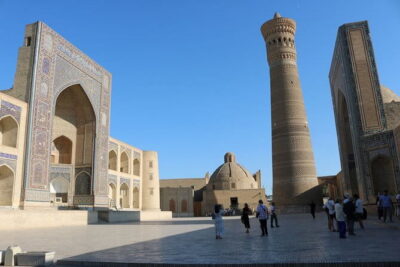
Bukhara: Private Guided Walking Tour with Hotel Pickup
Read our review →
2 – Days Guided Tour of Samarkand and Bukhara from Tashkent
Read our review →
Bukhara: Full-Day Guided Tour with English-Speaking Guide
Read our review →
Full-Day Private Guided Tour to Islamic 7 Saints of Bukhara
Read our review →Browse the lists this tour appears in