
Reviewed · WALKING TOURS IN BUKHARA
Bukhara: Walking Tour with a Small Group
Bukhara is easiest to understand on foot, and this tour gives you a remarkably full introduction in about four hours. You move from shaded trading domes and quiet courtyards to the huge Poi-Kalyan Ensemble, then out toward the Ark Fortress and the city’s oldest mausoleums. It is a lot of Bukhara in one walk.
I like two things here: the route covers nearly every major sight in the old town, and the professional guides add stories about daily life, crafts, religion, and politics rather than simply naming buildings. Guides such as Guli, Sunny, Mari, and Khurshida have earned especially strong praise for clear English, patient pacing, and useful restaurant advice.
The tradeoff is simple: this is a long sightseeing walk, with as many as 16 stops. Entry fees are not included, the Ark is viewed from outside, and wheelchair users will find the route unsuitable. Wear good shoes and expect a full afternoon rather than a gentle stroll.
Key points to know before you book
- Poi-Kalyan is the visual centerpiece: The Kalyan Minaret, Kalyan Mosque, and Miri Arab Madrasa form Bukhara’s most famous architectural group.
- You cover an unusually large number of sights: Trading domes, four madrasahs, mosques, the Ark, and three major mausoleums all fit into one route.
- The small group matters: Groups run from 2 to 8 people in late autumn and winter, and from 3 to 10 in spring through autumn.
- Craft workshops add local context: You may see carpet making, embroidery, metalwork, knife making, woodwork, or other traditional skills without being pressured to buy.
- The pace can be adjusted: Several guides have taken breaks, answered extra questions, and shaped the walk around the group.
- It is good value at $26: You are paying mainly for an experienced English-speaking guide and a well-planned route, not for admissions, meals, or transport.
Why this walk works so well in Bukhara
Bukhara’s historic center is not a single monument with a neat entrance and exit. It is a network of lanes, domes, courtyards, religious schools, old caravan stops, and open squares. You can wander on your own, but the meaning of the place is much easier to grasp when someone explains how the pieces fit together.
This walk begins near Nodir Devonbegi Madrasa, at the entrance gate by Lyabi-Hauz. From there, you head through the old city in a logical sequence, with frequent stops for explanation and photographs. The route is broad enough to give you a first look at Bukhara’s major landmarks, but it also includes smaller places that are easy to miss when you are following a map.
I especially like the balance between grand monuments and ordinary working spaces. One moment you are looking at blue tilework and monumental gateways. The next, you are inside a compact caravanserai or watching an artisan demonstrate a craft. That mix helps Bukhara feel like a living city, not a museum set.
The guides are a major part of the value. The experience is specifically led by professional guides rather than students or trainees. Names that appear often in the guide team include Guli, Sunny, Mari, Khurshida, Hayitgul, Vazira, Lola, and Suli. Their styles differ, but the strongest pattern is clear English, patience with questions, and an ability to connect architecture with Uzbek life.
More Walking Tours in Bukhara
- All You Need To Know About Bukhara. A Walk In The Town
★ 4.9 · 31 reviews - Bukhara Walking Tour
★ 4.7 · 25 reviews - Bukhara Historical City Highlights Guided Walking Tour
★ 4.5 · 16 reviews
Lyabi-Hauz begins the story
Lyabi-Hauz is one of the best places to start. Its historic pool, madrasahs, and khanaka create a social center in the middle of the old city. It is a place to pause and look around before the walking route becomes more concentrated.
Your guide can explain how water shaped life in Bukhara and why a pool surrounded by religious and civic buildings mattered so much. This opening stop also gives you a useful sense of scale. The city’s major sights are close together, but the details are dense, so the walk rewards a slower pace.
The meeting point is normally in front of the Nodir Devonbegi Madrasa entrance gate. Meeting details are sent through WhatsApp, so provide a working number when you book and arrive about five minutes early. The meeting point may vary with the option selected, so check the message rather than relying only on a general map pin.
Trading domes and the old Silk Road economy
From Lyabi-Hauz, the route takes you through several covered bazaars. These are not modern shopping malls. They are domed market structures built around particular trades, and their shape tells you a great deal about how Bukhara once worked.
At Toki Sarrafon, money changers once handled the needs of merchants moving through the city. The structure is compact, and its name preserves the connection with finance. It is a good place to ask about Bukhara as a trading center, since caravans needed more than inns and warehouses. They needed currency exchange, food, repairs, storage, and skilled workers.
Magoki-Attori Mosque is one of the oldest religious buildings on the route. Today it houses the Carpet Museum, adding another layer to the visit. The site is valuable even if you are more interested in architecture than carpets, because it shows how Bukhara’s buildings have changed purpose over time.
Toki Telpakfurushon is the largest covered bazaar included in the walk. It was once linked with sellers of hats and skullcaps. The covered design offered shade and helped organize commercial activity, but it can also feel visually crowded when other people are moving through. Stay close enough to hear your guide.
Abdullakhan Tim was built for silk trading. Its elegant dome and market layout help explain the importance of textiles in Central Asian commerce. Toki Zargaron, associated with jewelers, completes the picture by showing another specialized trade.
These stops are useful because they give you more than repeated views of grand facades. You see the practical side of old Bukhara: money, silk, hats, jewelry, and the buildings that supported them.
Two madrasahs, two different personalities
The Ulugbek Madrasa and Abdulaziz Khan Madrasa face each other and make a fine architectural pair. Ulugbek’s school is one of the city’s oldest Islamic institutions and is linked to Ulugbek, the Timurid ruler and astronomer. Its importance comes partly from its age and partly from the wider intellectual life associated with its founder.
Across from it, Abdulaziz Khan Madrasa is more decorative. Colorful mosaics, carved details, and a fuller display of ornament make it especially appealing to anyone who enjoys close architectural looking. Your guide can help you notice how patterns, inscriptions, and design choices differ between the two buildings.
This is one section where a guide earns the $26 price. Without context, you might see two impressive gateways and move on. With explanation, you begin to compare periods, patrons, decoration, and the role of education in Bukhara.
Do not expect every monument to be open in exactly the same way on every date. Some buildings may be under restoration. The guides can suggest alternate stops, but restoration coverings may still limit what you see.
Same city, a completely different day out:
- Best of Bukhara: All Day Private Old Town Tour
★ 5.0 · 66 reviews - Best of Bukhara: All Day Private Old Town Tour
★ 4.9 · 62 reviews - From Bukhara: 2-Day Desert Yurt Camp Tour
★ 4.5 · 57 reviews - City Tour Around Bukhara
★ 5.0 · 55 reviews
Poi-Kalyan, Bukhara’s great postcard view
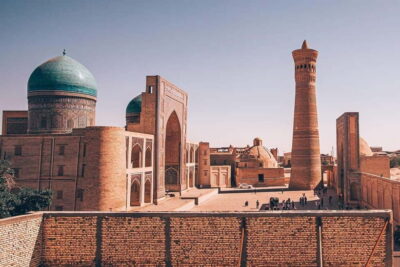
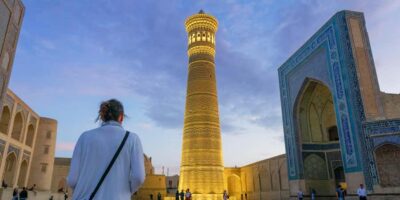
The route then reaches the Kalyan Minaret, Kalyan Mosque, and Miri Arab Madrasa. Together they form the Poi-Kalyan Ensemble, the point most people picture when they imagine Bukhara.
The 12th-century Kalyan Minaret is the group’s vertical anchor. Its height and brick patterning make it visible from many parts of the old city. The minaret is not just a pretty tower. It was a landmark for people approaching Bukhara and part of the city’s religious and civic identity.
Kalyan Mosque is broad and imposing, with room for up to 10,000 worshippers. The open courtyard gives you a chance to understand its scale, especially after the tighter trading domes. Ask your guide to point out the relationship between the mosque, the minaret, and the madrasa across the square.
Miri Arab Madrasa sits opposite the mosque and remains an active Islamic school. That matters when you visit. Dress modestly, keep your voice respectful, and follow your guide’s instructions about where you may look or enter. This is not merely a historic shell.
The Poi-Kalyan area can be busy and bright, and it is often the most photographed part of the walk. Give yourself a moment to look beyond the standard picture. The brickwork, tile color, courtyard proportions, and framed views between buildings are all worth attention.
The Ark and Bolo-Hauz change the mood
The walk continues toward the Ark Fortress, the ancient citadel of Bukhara’s rulers. The Ark now serves as a state museum, but this tour views it from outside. Entering the museum sections would add roughly one to one and a half hours, so the decision keeps the walking tour within its stated four to four and a half hours.
Seeing the Ark from outside still gives you a sense of its massive defensive role. It is less delicate than the madrasahs and bazaars, and that contrast is useful. Bukhara was a center of learning and trade, but it was also a seat of power.
Some afternoon departures reach the Ark area near sunset, which can make the exterior particularly attractive for photographs. Timing varies, so do not book the walk only for a guaranteed sunset view.
Bolo-Hauz Mosque is nearby and has a very different feel. Its long wooden pillars and reflection pool make it one of the most graceful stops. The pool also connects it visually with Lyabi-Hauz, but the architecture gives this setting a more open and ceremonial character.
Three final monuments and a longer walk
The final section includes Chashma-Ayyub Mausoleum and the Ismail Samani Mausoleum. Chashma-Ayyub means Job’s Spring and is tied to a local story about the Prophet Job. The building is memorable for its unusual roof forms, and the legend gives your guide a chance to connect place, faith, and storytelling.
The Ismail Samani Mausoleum is the architectural high point for many people who prefer age and craftsmanship over colorful tile. Built in the 10th century, it is described as the oldest monument in Bukhara and is widely valued for its brick construction and geometric design.
Reaching these monuments means walking beyond the tightest core of the old city. That is one reason the tour feels so complete, but it also makes the route physically demanding. Several people have praised guides for waiting while the group takes photographs and for offering tea-house breaks. Still, you should bring water, wear comfortable shoes, and be ready to walk for most of the afternoon.
Craft workshops without a shopping-centered agenda
The tour includes a few artisan workshops to show local work and present a side of Bukhara that monuments cannot provide. Depending on the route and what is open, you might see carpet work, Suzani embroidery, metal carving, knife making, woodwork, or other crafts.
This is not presented as a shopping tour. No payment is expected during the workshop visits, and the purpose is to see how objects are made and to hear about local skills. You can choose to return later to buy something, but you are not expected to purchase on the spot.
I consider this a real strength, with one practical qualification. If you dislike any stop connected with crafts or shops, tell your guide early. The workshop visits are optional in spirit, but they are part of the cultural design of the walk. For many people, they provide a welcome break from monuments and a closer look at present-day Bukhara.
Some guides add small touches that make the walk more social, such as quiz questions, local legends, tastings, or demonstrations of everyday customs. These details vary by guide and day, so treat them as possible extras rather than guaranteed stops.
Group size, pace, and guide quality
The group limit is 2 to 8 people in late autumn and winter, and 3 to 10 in spring through autumn. That is small enough for questions and conversation, but not necessarily private. If fewer people book, the experience may feel almost private, particularly in low season.
The guide team’s strongest quality is personal attention. Guides have adjusted the pace for solo participants, taken rest stops, helped families with children, and offered suggestions for restaurants and additional sights after the walk. That is useful because Bukhara is the sort of city where a good lunch recommendation or a tip about the bazaar can improve the rest of your stay.
At the same time, the route is ambitious. You will not receive an hour at every monument. The guide must keep the group moving, and some sites may be explained from the outside or visited briefly. If your main goal is detailed museum study, a private custom tour or separate visits would suit you better.
Is $26 good value?
At $26 per person, I consider this strong value for a first visit. You receive a professional English-speaking guide, a four to four and a half hour walking route, online support, and access to a carefully organized introduction to most of central Bukhara.
The price does not include monument entry fees, meals, drinks, or pickup and drop-off. Bring some cash for personal expenses and admissions. The advertised skip-the-ticket-line feature may save time where it applies, but it does not mean every entry charge is covered.
You pay for interpretation and organization rather than transportation. That is the right arrangement in Bukhara, where the historic core is best experienced on foot and the distances between major sights are manageable. A self-guided walk costs less, but it will not give you the same background on trade, religious education, crafts, and local customs.
Who should book this Bukhara walk?
I would choose this tour if you have one or two days in Bukhara and want to get your bearings quickly. It also suits anyone who likes a full sightseeing route, asks questions, and wants practical suggestions for food and further exploring.
Families can benefit from the flexible pace, especially with a patient guide such as Sunny or Mari. Solo visitors may find a small group more enjoyable than walking alone. History fans will appreciate the number of major sites, while first-time visitors will like having the old town’s layout explained in plain terms.
You should think twice if long walks are difficult, if you need step-free access, or if you want to spend extended time inside each monument. The tour is not suitable for wheelchair users, and the route’s number of stops means it favors breadth over slow study.
Free cancellation is available up to 24 hours before the start, and you can reserve now and pay later. The operator may cancel for severe weather or if the minimum number of participants is not reached, with a choice of a full refund or another available date.
Should you book it?
Yes, if you want a strong first look at Bukhara without arranging separate visits to every major monument. The combination of Poi-Kalyan, Lyabi-Hauz, the trading domes, Ark, Bolo-Hauz, and the mausoleums gives you an unusually broad picture for $26.
Book it early in your stay so the guide’s restaurant tips, craft suggestions, and extra sightseeing ideas can shape your remaining time. Choose comfortable shoes, modest clothing for mosque visits, and a willingness to keep moving. If you prefer a private, slow architectural study, choose something more tailored. For most first-time visitors, this is an efficient and human way to meet Bukhara.
FAQ
How long does the walking tour last?
The tour lasts about four to four and a half hours. The exact start time can vary, so check availability when booking.
What language is the tour conducted in?
The tour is conducted in English with a live professional guide.
How large is the group?
Late autumn and winter groups have 2 to 8 participants. Spring through autumn groups have 3 to 10 participants.
Where does the tour meet?
The usual meeting point is in front of the entrance gate of Nodir Devonbegi Madrasa at Lyabi-Hauz. The meeting point can vary by booking option, and details are sent through WhatsApp.
Are entrance fees included?
No. Entry fees, meals, drinks, and pickup and drop-off are not included.
Is the Ark Fortress visited inside?
No. The Ark is shown from the outside on this tour. Visiting its museum sections would add about one to one and a half hours.
What should I bring and wear?
Arrive five minutes early, bring some cash for personal expenses, wear comfortable walking shoes, and dress modestly when visiting mosques. Respect for local customs and traditions is expected.
Just added around Bukhara
- Bukhara: City Highlights Guided Tour with Pickup★ 5.0 · 3 reviews
- Full-Day Private Guided Tour to Islamic 7 Saints of Bukhara★ 4.5 · 3 reviews
- Uzbekistan 8 Days Private Guided Tour★ 4.6 · 3 reviews
- 9 Days Private Guided Tour to Uzbekistan★ 5.0 · 3 reviews
- Legends of Bukhara: Exclusive Full-Day Tour★ 5.0 · 4 reviews
- Bukhara Walking Tour★ 5.0 · 4 reviews
- 2 Day Ukhum Hiking Tour from Bukhara★ 5.0 · 4 reviews
- Bukhara day tour★ 4.0 · 4 reviews
Walking Tours in Bukhara, compared.
All You Need To Know About Bukhara. A Walk In The Town
Read our review →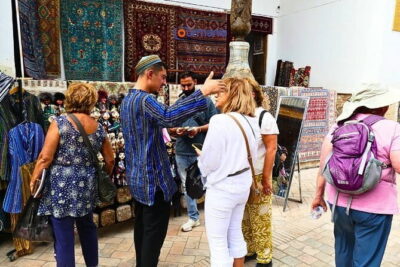
Bukhara Historical City Highlights Guided Walking Tour
Read our review →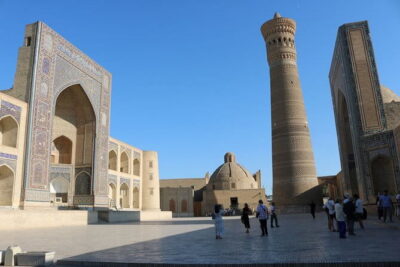
Bukhara: Private Guided Walking Tour with Hotel Pickup
Read our review →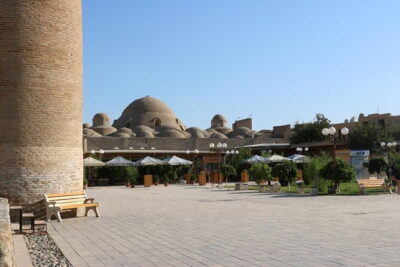
Browse the lists this tour appears in