
Reviewed · BUKHARA TOURS
Bukhara in a Day History, Culture, and Local Insight Private Tour
Bukhara’s old city is best understood one layer at a time: a tea house here, a trading dome there, then a blue-tiled madrasa or ancient fortress. This private tour brings the main sights into one efficient route, with guide Yulduz offering the kind of local explanation that turns old walls into readable stories.
I especially like the private format, since you can set the pace and ask questions without waiting for a large group. I also like the mix of famous monuments and everyday crafts, including silk carpets, puppets, ceramics, bread, tea, and Bukhara’s classic dishes. The main consideration is cost at the sights: the $80 tour price does not cover all entrance fees, and meals are not included.
Key points to know before booking
- A private four-hour route: Your group of up to six receives its own licensed guide, with pickup offered and a finish near the Ark.
- A strong old-city introduction: The route covers Lyab-i-Hauz, the Trading Domes, major madrasas, Poi Kalyan, the Ark, and Bolo Hauz Mosque.
- Guide Yulduz is a major draw: She is praised for clear explanations, entertaining storytelling, and adjusting the pace to suit the group.
- Crafts add local texture: The experience discusses handmade silk carpets, puppet making, food traditions, and the plant-based method linked with Bukhara’s famous blue ceramics.
- Budget for admissions: Several major sites require extra payment, listed as $7 per person for the main paid attractions.
- You finish at the Ark: This is useful if you want to continue exploring the citadel area after the tour.
A smart way to meet Bukhara in four hours
The tour begins at 9:00 a.m. by the Nasreddin Afandi statue, near Lyab-i-Hauz. Afandi is a familiar figure in Central Asian folklore, often shown as a humorous wise man, so the meeting point gives the morning a distinctly local start rather than dropping you at a generic hotel lobby.
From there, you follow a compact old-city route. The listed sightseeing time adds up to about three hours and 50 minutes, while the full experience is advertised at roughly four hours and 20 minutes. That extra time allows for walking, transitions, questions, and the guide’s explanations.
This is not a drive between distant sights. The main value comes from moving through Bukhara’s historic center at street level. Pickup is offered, but you should confirm the exact arrangement when booking, since the stated meeting point is the Nasreddin Afandi statue and the official end is on Afrosiab Street near the Ark.
More historic sites near Bukhara:
- Bukhara: Historic Center Guided Sightseeing Tour
★ 4.8 · 44 reviews - Bukhara Historical City Highlights Guided Walking Tour
★ 4.5 · 16 reviews - Samarkand: Historical Monuments Guided Walking Tour
★ 4.8 · 446 reviews
Lyab-i-Hauz: tea, stories, and a calm first stop
The first scheduled stop is Lyab-i-Hauz, with about 40 minutes here. The name refers to the pool at the center of this well-known gathering place, surrounded by old buildings, shade, and public space.
This is a good opening because it lets you get your bearings before the route grows more architectural. Your guide can place Bukhara’s social life alongside its monuments, helping you see the city as more than a collection of tiled facades.
The wider experience also places food and drink near the beginning of the day. You may hear about plov, shashlik, manti, fresh flatbread, and fragrant green tea, all tied to recipes and customs passed through local kitchens. Meals are not included, and the itinerary does not promise a formal tasting, so treat this as cultural context unless your guide confirms a food stop.
Lyab-i-Hauz is also where the tour’s local angle matters most. A good explanation of how people used public spaces, tea houses, and market areas can make the rest of the walk easier to understand.
The Trading Domes: Bukhara’s Silk Road shopping streets
Allow about 40 minutes for the Trading Domes. These covered markets date from the 16th and 17th centuries and once handled important commercial activity along the Silk Road.
The domes are not a single market hall. They are a group of historic vaulted commercial spaces, including Toqi Sarrafon, once associated with money changers. As you pass through, look for the way the domed roofs organize movement, shade, and trade.
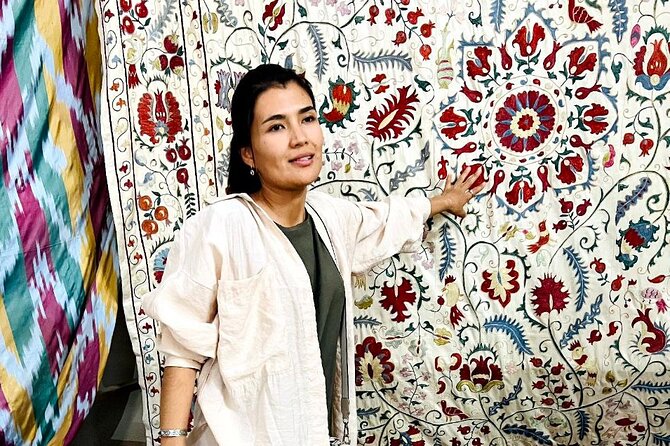
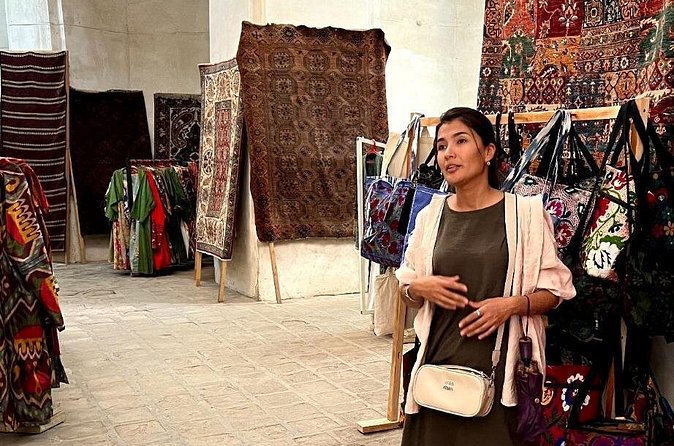
This is where the tour’s carpet discussion becomes especially useful. You can learn how handmade silk carpets differ from machine-made silk carpets. Handmade pieces have intricate knots, natural dyes, and small variations that give each one a distinct character. Machine-made silk tends to be more even and uniform, but lacks the same individual marks.
A local workshop visit is described as part of the cultural focus, with artisans showing the painstaking work behind a carpet. Still, the exact workshop timing is not separately listed in the stop-by-stop schedule. If carpets are important to you, ask Yulduz at the start how much time will be given to the craft side of the tour.
Magoki Attori Mosque and the carpet connection
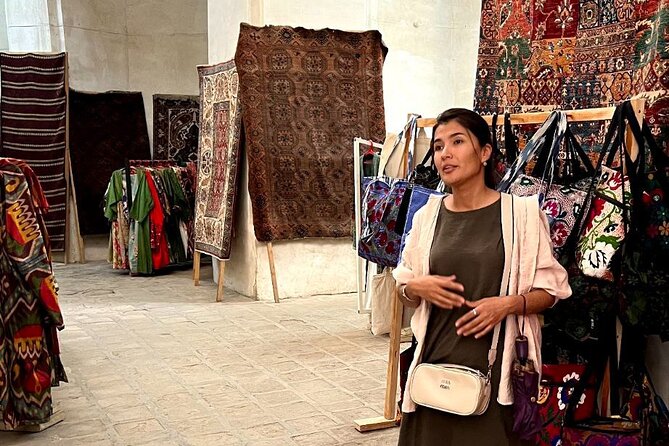
The Magoki Attori Mosque receives about 20 minutes. It is described as one of Bukhara’s oldest treasured sites, with origins preserved from the 12th century. Its age is the point here: this is a place where layers of Bukhara’s religious and urban past meet in a relatively short stop.
The mosque also connects naturally with the carpet portion of the experience. A carpet museum is included in the description of this stop, giving you a chance to look at the craft as more than a shopping product. You can focus on knotting, materials, dyes, and the patience required to make a serious silk carpet.
Admission is not included at this stop. The tour information also marks several other monuments as paid, so carry local currency or a suitable payment method and expect the final cost to be higher than the guide fee alone.
Twenty minutes is enough for an introduction, but not for a slow museum visit. If you like to read every display or inspect carpets closely, you may need to keep your expectations measured.
A few more Bukhara days to weigh up
- Bukhara: Walking Tour with a Small Group
★ 4.9 · 260 reviews - Best of Bukhara: All Day Private Old Town Tour
★ 5.0 · 66 reviews - Best of Bukhara: All Day Private Old Town Tour
★ 4.9 · 62 reviews - From Bukhara: 2-Day Desert Yurt Camp Tour
★ 4.5 · 57 reviews
Ulugbek and Abdulaziz-Khan: two madrasas, two different stories
The Ulugbek Madrasa gets 15 minutes. It dates from the 15th century and was commissioned by Ulugbek, the Timurid ruler and astronomer. That detail gives the building a useful place in the wider story of Central Asian learning, where religious education and scientific interests could exist within the same world.
The stop is brief, so expect an exterior-focused explanation and a look at the architecture rather than a long period inside. For many people, that is enough to understand the building’s role and compare it with the next madrasa.
The Abdulaziz-Khan Madrasa receives 10 minutes. Begun in the 17th century under Khan Abdulaziz, it is known for a grand design that was never fully completed. That unfinished quality makes it different from a polished monument: you can see ambition, decoration, and incompletion in the same place.
Admission is listed as not included here. The short visit works well if your goal is to see the key old-city buildings in one morning. It may feel rushed if your main interest is architectural detail, tile patterns, or photographing every courtyard.
Poi Kalyan: Bukhara’s most dramatic landmark group
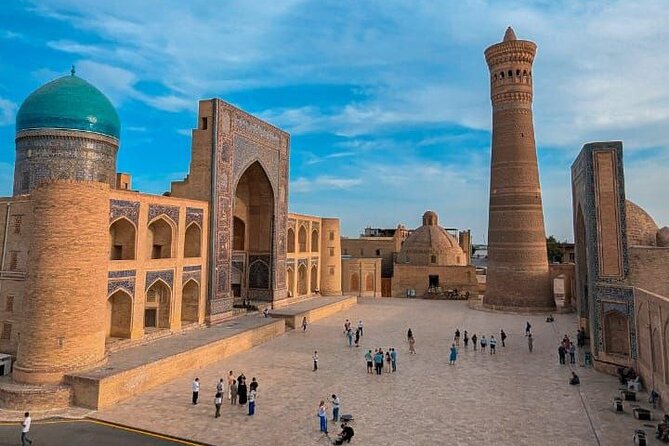
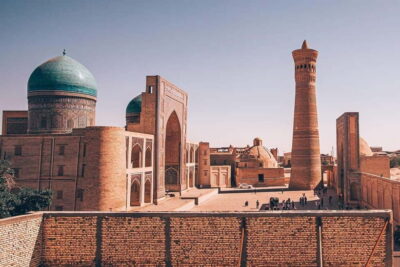
About 30 minutes are set aside for the Poi Kalyan complex. This is one of the route’s visual high points, with the 12th-century Kalon Minaret rising above the surrounding buildings.
The minaret is noted for its height and patterned brickwork. It served both as a watchtower and as a place connected with the call to prayer, so it had practical as well as religious importance. Ask your guide to point out the brick patterns and explain how the tower fits into the larger complex.
The Poi Kalyan Mosque is also among the paid attractions. The tour information lists $7 per person for entry to the main paid sites, including Poi Kalon Mosque, though individual admission arrangements can change. The guide fee does not cover that amount.
Thirty minutes gives you time to take in the scale, hear the main story, and make photographs. It does not allow for a long, unhurried architectural study. I would keep your camera ready and listen closely during the explanation, since the schedule moves on to the Ark.
The Ark of Bukhara: a fortress with a long political life
The route saves a full hour for the Ark of Bukhara, and that is sensible. This massive citadel is one of the city’s central landmarks and is described as more than 2,000 years old. It served as the residence and seat of power for Bukhara’s rulers.
Inside, the Ark gives the tour a change of scale. After courtyards, markets, and religious schools, you are looking at a fortified complex tied to government, royal life, and defense. A full hour allows your guide to explain the site without reducing it to a quick photograph from outside.
Admission is not included. Since the tour ends near the Ark, you can also decide to remain in this area afterward, depending on your plans and ticket arrangements. The endpoint is practical: you do not need to retrace the entire route to continue exploring around the citadel.
The Ark is the stop most likely to benefit from a guide’s storytelling. Large fortresses can feel confusing without a clear sense of who used each area and why it mattered. Yulduz’s role here is to connect the physical remains with Bukhara’s rulers and changing fortunes.
Bolo Hauz Mosque and the final look at old Bukhara
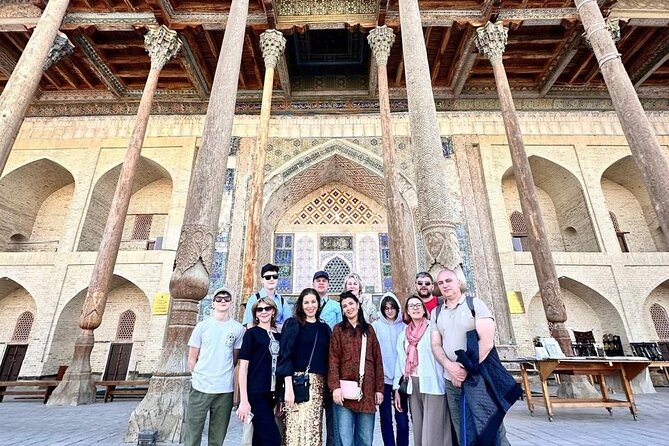
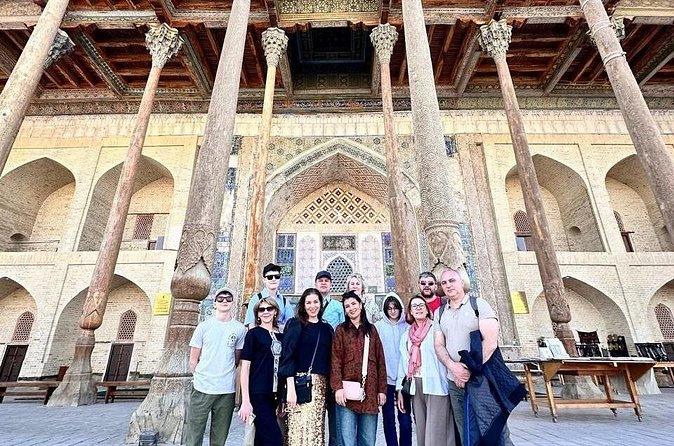
The final scheduled stop is Bolo Hauz Mosque, with about 15 minutes. Located near the Ark, it is known for carved wooden columns supporting the mosque’s roof.
Those columns provide a useful contrast with the brick domes and tilework seen earlier. Bolo Hauz is not simply another stop on a checklist. Its woodwork gives you a different way to read local building traditions and lets the route end on a more intimate architectural note.
The mosque has free admission according to the supplied details. Since the official tour endpoint is listed at the Ark rather than Bolo Hauz, confirm with the guide how the final walk is handled on the day. The two sites are near each other, so this should be easy to clarify.
Carpets, puppets, and blue ceramics
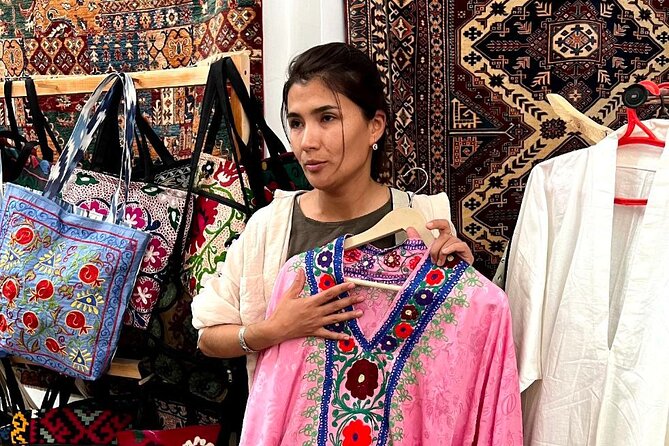
The cultural material is broader than the monument route. You are introduced to traditional puppet making, including colorful marionettes used in storytelling performances. That is a small but memorable subject, especially if you want to see how local culture is carried through performance and handcraft rather than only through grand buildings.
Ceramics receive their own unusual detail. Bukhara’s famous blue color is linked here with the use of a desert plant. The tour gives you a chance to ask how that plant is used in the coloring process and how local ceramic traditions developed.
The food material rounds out the picture. Plov, shashlik, manti, flatbread, and green tea are presented as part of Bukhara’s living culture. These details matter because they connect the city’s past with things you can still see and taste today.
The schedule does not assign separate minutes to a puppet workshop, ceramics workshop, or meal. I would consider them supporting themes unless your guide confirms a specific visit. That distinction is important if you are booking mainly for hands-on craft demonstrations or a included lunch.
What the guide adds to the route
The strongest part of this experience is the guide relationship. Yulduz is the named guide associated with the tour, and the available feedback repeatedly singles out her clear explanations, efficiency, and flexible pacing.
That flexibility matters in a private group. You can ask for more detail at the Ark, spend less time in a market, or pause for questions about customs and daily life. One account specifically describes seeing Bukhara’s major sights efficiently while the guide adjusted the pace.
You can also request Yulduz when booking, though guide availability should be confirmed rather than assumed. The experience is designed for your group alone, not a mixed party, which makes it a better fit for families, couples, and friends with different interests.
Most travelers can participate, and service animals are allowed. Public transportation is nearby, but the tour itself is built around the old city, so comfortable walking shoes remain a sensible choice.
Is $80 a good value?
At $80 per group for up to six people, the guide fee can be very reasonable. A full group pays about $13.33 per person before admissions, while a solo visitor pays the entire $80. The value improves sharply when shared by several people.
The fee includes a professional guide and bottled water. It does not include meals or entrance fees. The listed paid admissions total $7 per person for Lyabi Hauz, Abdulazizkhan, Poi Kalon Mosque, and the Ark, though the stop details also mark Magoki Attori as not included. Confirm the exact current ticket total before you go.
For a first morning in Bukhara, the price makes sense if you want a structured introduction and strong historical explanation. If you prefer to wander slowly, spend a long time shopping, or focus on one museum, a private guide covering eight stops may feel too fast.
Free cancellation is available if you cancel at least 24 hours before the start time. Changes or cancellations inside that window are not refunded, and the cut-off follows local time.
Who should book this Bukhara tour?
I would choose this experience if you have one main day in Bukhara and want to see the major old-city sights without sorting out the route yourself. It is also a good fit if you value questions, personal pacing, and explanations that connect architecture with food, crafts, religion, and local customs.
Families and small groups get particular value from the private setup. You can keep the pace together and avoid forcing everyone to follow a large group’s timetable.
I would hesitate if your priority is a formal food tour, a guaranteed workshop session, or extensive time inside every monument. The route mentions these cultural subjects, but the timed schedule is mainly built around historic buildings and the Ark.
FAQ
How long does the Bukhara tour last?
The experience lasts approximately 4 hours and 20 minutes and begins at 9:00 a.m.
Where does the tour begin?
The meeting point is the Khodja Nasreddin statue, also called the Nasreddin Afandi statue, at QCFC+5FM in Bukhara.
Where does the tour end?
The tour ends on Afrosiab Street near the Ark of Bukhara, at QCH5+6W6.
How many people can join the private tour?
The $80 price covers one private group of up to six people.
Are entrance fees and meals included?
No. Meals are not included, and entrance fees are extra. The listed admissions are $7 per person for Lyabi Hauz, Abdulazizkhan, Poi Kalon Mosque, and the Ark, while some stop details also mark Magoki Attori as not included.
Can I cancel for a full refund?
Yes. You can receive a full refund if you cancel at least 24 hours before the experience starts. Cancellations or changes made less than 24 hours before the start time are not refunded or accepted.
Should you book it?
Book this tour if you want a well-paced introduction to Bukhara’s old city, with the major monuments covered in one private morning and a guide who can answer questions in detail. The combination of Lyab-i-Hauz, the trading domes, madrasas, Poi Kalyan, the Ark, and Bolo Hauz gives you a strong first look at the city.
Before paying, confirm the guide, the exact craft or food elements included that day, and the current entrance total. If you do that and accept the short stops, $80 for a group of up to six is a practical way to get oriented in Bukhara without losing the local color that makes the city special.
Just added around Bukhara
- Bukhara: City Highlights Guided Tour with Pickup★ 5.0 · 3 reviews
- Full-Day Private Guided Tour to Islamic 7 Saints of Bukhara★ 4.5 · 3 reviews
- Uzbekistan 8 Days Private Guided Tour★ 4.6 · 3 reviews
- 9 Days Private Guided Tour to Uzbekistan★ 5.0 · 3 reviews
- Bukhara Walking Tour★ 5.0 · 4 reviews
- Legends of Bukhara: Exclusive Full-Day Tour★ 5.0 · 4 reviews
- 2 Day Ukhum Hiking Tour from Bukhara★ 5.0 · 4 reviews
- Bukhara day tour★ 4.0 · 4 reviews
Bukhara Tours, compared.
Bukhara: Historic Center Guided Sightseeing Tour
Read our review →
All You Need To Know About Bukhara. A Walk In The Town
Read our review →Browse the lists this tour appears in