
Reviewed · KHIVA TOURS
Khiva day tour
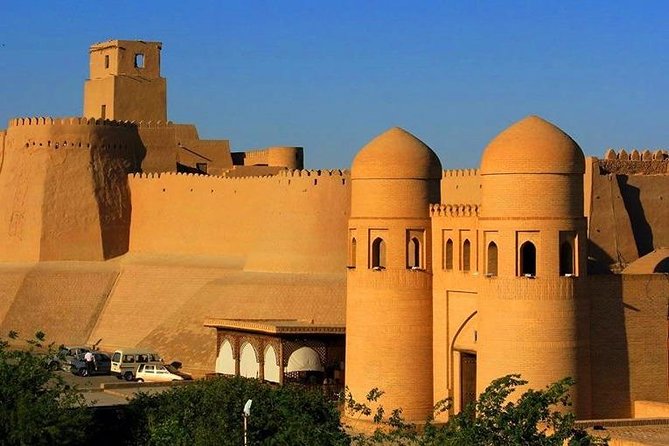
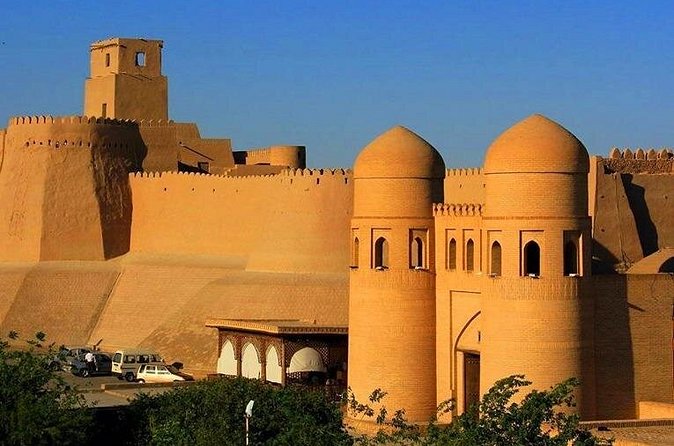
Khiva’s Itchan-Kala Fortress is the kind of place that rewards context. Behind its thick walls, blue-tiled minarets, carved wooden columns, royal courtyards, old madrasahs, and sacred buildings sit close together, and this private tour gives you a clear route through the medieval walled city.
I like the small private format, since your guide can adjust the explanation to your interests instead of delivering a fixed speech. I also like the steady pace reported by several customers, with guides arriving on time and covering the main sights without making the day feel hurried.
The main catch is simple: admission tickets are not included, and the $60 price also excludes taxes and personal expenses. You should confirm the extra entrance costs before setting out, especially if you want to enter several of the paid monuments.
Key points at a glance
- A full morning inside Itchan-Kala: The 8:00 am start gives you roughly 5 to 6 hours among Khiva’s principal monuments.
- Private attention: Only your group takes part, so you can ask questions and request more or less detail.
- A strong list of sights: The route includes Kunya-Ark, Tash-Khovli Palace, Juma Mosque, Kalta-Minor, and the Islam-Khoja Minaret.
- Useful historical guidance: The tour helps you understand how Khiva functioned as a fortified city, royal seat, religious center, and stop along Central Asian trade routes.
- Practical comfort: Bottled water and air-conditioned transportation are included.
- Budget point to remember: Monument admission, taxes, and personal spending are extra.
Starting inside Khiva’s walled old city
The tour begins at 8:00 am at Itchan-Kala, at Boltaeva 41 in Khiva. This is a practical starting point because the fortress itself is the main subject of the morning, not just a meeting place before a long drive.
Itchan-Kala is Khiva’s enclosed old city, filled with monuments from several periods. You will not be ticking off isolated sights in different parts of town. Instead, the tour connects mosques, schools, palaces, mausoleums, and towers within one compact historic setting.
That arrangement matters. Without a guide, it is easy to admire the turquoise tile and carved wood while missing the different roles these buildings played. A good explanation helps you see the difference between a madrasah used for religious study, a mosque used for worship, a royal palace built for court life, and a fortress designed for defense.
The experience is private, so the pace can suit your group. Several comments describe a tour that covered a lot without feeling rushed, and one account specifically notes that the guide adjusted explanations to the group’s interests. That is useful in a place with a long list of monuments and plenty of dates to remember.
A few more Khiva days to weigh up
- Khiva: Historical City Highlights Guided Walking Tour
★ 4.8 · 156 reviews - Transfer: Bukhara – Khiva via Ancient Fortresses
★ 4.5 · 101 reviews - Daytrip From Khiva To Ancient Fortresses
★ 4.6 · 60 reviews
Mukhammad Aminkhan Madrasah and the unfinished Kalta-Minor
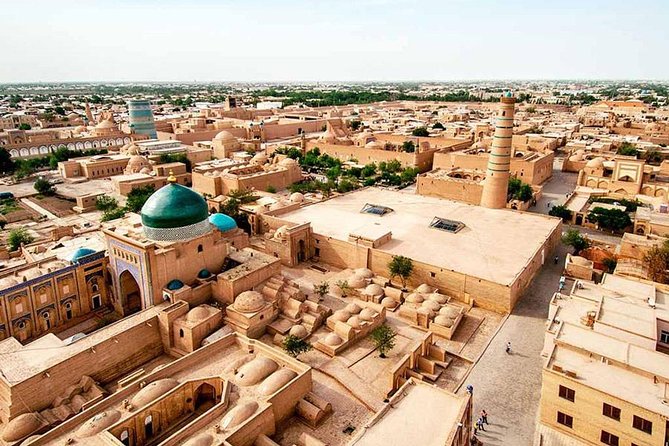
One of the first major sights is Mukhammad Aminkhan Madrasah, built between 1851 and 1854. A madrasah was a center for Islamic learning, and this building gives you an early sense of Khiva’s religious and civic importance.
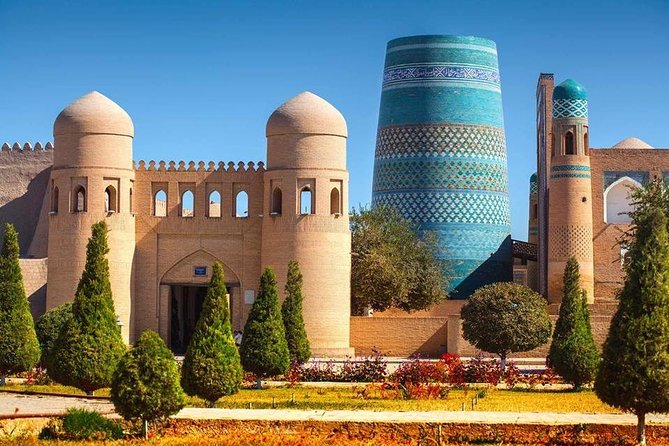
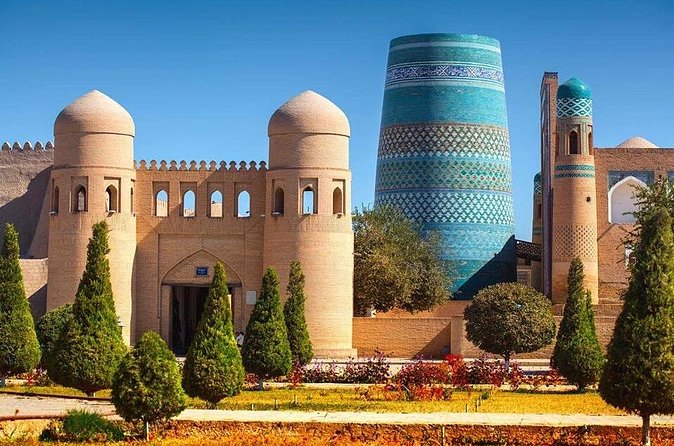
The nearby Kalta-Minor is one of the city’s most recognizable features. Begun in 1855, the short, broad minaret is covered in colored tile and has an unusual appearance compared with the tall, slender towers found elsewhere in Central Asia.
Its unfinished state is part of its character. You get a sense of an ambitious project that did not reach its intended height, rather than another perfectly completed monument. This is a good place to ask your guide how Khiva’s rulers used architecture to display power.
The stops are visually strong, but keep your expectations realistic. The tour description names the buildings and their dates, yet it does not promise extended interior visits at every site. Since admission tickets are separate, ask your guide which monuments are open and which entrances make the most sense for your interests and budget.
Mukhammad Rahimkhan Madrasah, dated to 1876, adds another layer to the route. Seeing these buildings together lets you compare design, scale, and purpose rather than treating each one as a standalone photo stop.
Kunya-Ark, the fortress within the fortress
Kunya-Ark means the old fortress, and it is one of the most important parts of the morning. It served as the khan’s citadel and offers a way to understand how Khiva’s rulers lived and governed from inside the larger walled city.
The name can cause confusion. Itchan-Kala is the fortified old city, while Kunya-Ark was an additional fortified complex within it. Your guide’s role is especially useful here, because the relationship between the two walls and their functions is easy to miss when you explore alone.
Expect a mix of royal, defensive, and ceremonial spaces. The attraction is not only a single grand room. It is the chance to picture the workings of a khan’s court, with authority concentrated behind another layer of walls.
Kunya-Ark is also a good place to pay attention to the city’s sense of scale. The old city is compact enough to explore on foot, but the fortress shows how much organization was packed into that enclosed space.
The tour’s 5 to 6-hour length gives you time to spend more than a few minutes at the main sites. Still, your exact time inside Kunya-Ark may depend on entrance arrangements and your group’s interests. The private format makes it easier to linger if a particular courtyard or historical detail catches your attention.
Juma Mosque and Khiva’s carved wooden columns
Juma Mosque, dated to the 18th century, offers a different mood from the tiled façades outside. Its interior is known for a forest of wooden columns, creating a quieter and more shaded space within the stone city.
This stop helps balance the tour. Khiva is famous for its bright blue tile and tall minarets, but the mosque shows how atmosphere can come from wood, shadow, repetition, and carefully controlled light.
A guide can help you look closely at the columns instead of treating the building as a quick interior visit. Ask about the age, decoration, and arrangement of the columns if those details interest you. The supplied information does not specify which parts are open on a particular day, so access may vary.
Juma Mosque also provides a useful pause in a morning filled with monumental architecture. On a hot day, that matters. One customer described taking the tour in very hot weather and still found that the guide kept to the planned sights. Bottled water is included, but you should still dress for heat and carry anything else you personally need.
Same city, a completely different day out:
- Ayazkala, Toprakkala & Kizilkala Fortress Tour From Khiva
★ 4.3 · 33 reviews - Aral Sea Adventures (2 day)
★ 5.0 · 30 reviews - Khiva Historical City Highlights Guided Walking Tour
★ 5.0 · 30 reviews - Master Class – Shivit Osh Traditional Food Of Khiva
★ 4.2 · 27 reviews
Tash-Khovli Palace and the world of the khan’s court
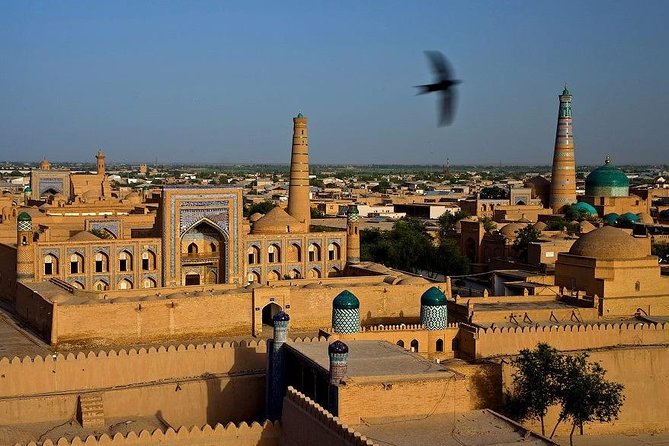
Tash-Khovli Palace, built in the 19th century, is one of the tour’s strongest stops for understanding royal life. Its courtyards and decorative spaces show how the khan’s court was separated into formal, private, and administrative areas.
The palace is valuable because it puts human activity back into the monuments. You can think about receptions, household life, ceremonies, and the strict divisions that shaped life at court, not just about tile patterns and dates.
The decoration rewards a slower look. Pointed arches, painted surfaces, carved wood, and blue-green tile work appear in combinations that are distinct from the austerity of a fortress wall or the repeated columns of Juma Mosque.
Do not expect every room to feel fully explained by a plaque. This is one of the places where a well-informed guide can make a large difference. Charos is named in the feedback as a punctual and attentive guide who maintained the full route on a hot day. Other guides are not named, so you should not assume Charos will lead every departure, but you can request her when booking if that option is available.
Pakhlavan Makhmud Mausoleum and living religious tradition
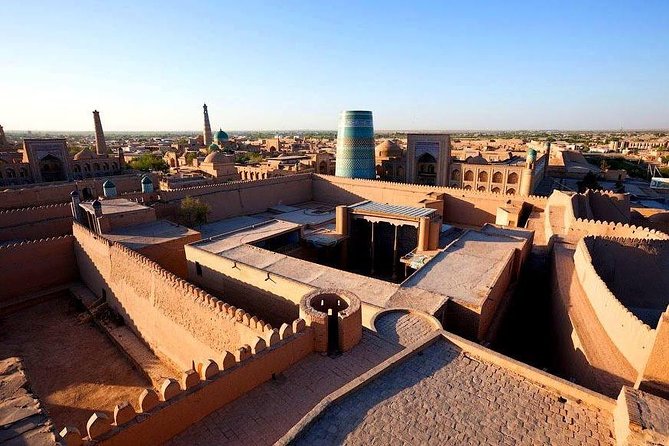
The Pakhlavan Makhmud Mausoleum, dated here to 1701, introduces a more personal and spiritual side of Khiva. It honors Pakhlavan Makhmud, a respected figure associated with the city, and remains one of the important religious monuments within Itchan-Kala.
Mausoleums require a different kind of attention from palaces. The point is not only architectural display. You are entering a place connected with memory, devotion, and local identity.
Your guide can explain the figure commemorated here and how the mausoleum fits into Khiva’s religious life. As with the other monuments, entrance fees are not part of the tour price, so budget for admission if you want to go inside.
This stop may appeal most to you if you want more than a procession of grand buildings. It gives the day emotional variety and helps explain why Khiva is not simply an open-air museum.
Please follow any posted rules about dress, photography, and behavior. The supplied details do not state the exact restrictions, so listen to your guide at the entrance.
The Islam-Khoja Minaret and the final view of Khiva
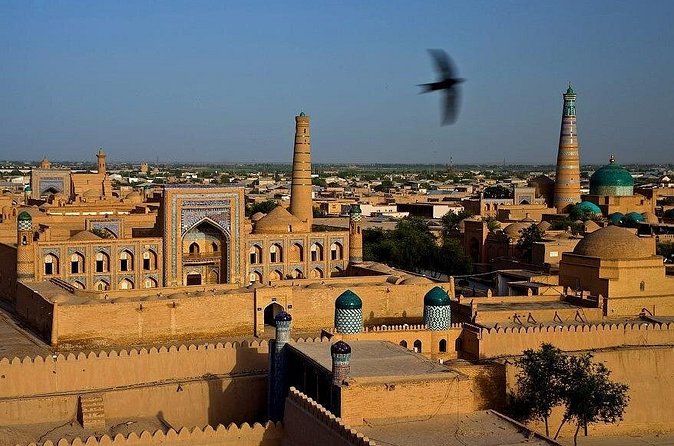
The Islam-Khoja Minaret, built in the 19th century, is another major landmark on the route. Its height and narrow profile contrast sharply with the wide Kalta-Minor, giving you two very different examples of minaret design in the same city.
The minaret is tied to the Islam-Khoja complex, which also includes a madrasah. From ground level, look at the bands of tile and the gradual narrowing of the tower. The guide can connect the building to the modernization and political ambitions of late Khiva.
The published information does not confirm that climbing the minaret is included or available. Do not book this tour expecting a guaranteed ascent. The reliable promise is a guided visit to the major Itchan-Kala monuments, not a particular rooftop view.
By the time you reach this part of the route, the sequence of buildings begins to make sense. You have seen education, worship, royal authority, burial, and defense. The minaret becomes more than a striking tower. It is another piece of the city’s public and religious identity.
The activity ends back at the meeting point. That is convenient if you are staying in or around Itchan-Kala and want to continue exploring on foot afterward.
What the $60 price gives you
At $60 per person, this is not the cheapest way to walk around Khiva. It is also not just a transfer or a quick orientation. The price covers a private guide, air-conditioned transportation, and bottled water for a 5 to 6-hour experience.
The strongest value comes from the time and interpretation. Itchan-Kala contains enough monuments to overwhelm you, particularly if you are trying to remember names, dates, and functions while also taking photographs. A private guide can organize the morning and explain why each place matters.
You are paying for more than access, since entrance fees are extra. Add the cost of the monuments you choose to enter before deciding if the total fits your budget. If you only want exterior views and a short walk, you may find the price high. If you want a structured explanation of the city’s main sights, the cost is easier to justify.
Group discounts are offered, though the available discount and group size are not specified. Ask about the total price for your party before booking. Since this is a private activity, the per-person cost may feel more reasonable when shared by a larger group, especially if everyone wants the same pace and level of explanation.
Timing, transport, and the hot-weather question
The 8:00 am start is sensible for a long sightseeing morning. It gives you an early beginning before the day becomes more tiring, and the stated duration leaves enough time for the principal monuments.
You should be prepared for substantial walking inside Itchan-Kala. The information confirms air-conditioned transportation is included, but it does not say that a vehicle is used for every movement within the fortress. Treat this primarily as a guided historic-city visit and wear comfortable shoes.
Bottled water is provided, which is a useful touch in Khiva’s heat. One account specifically describes a very hot day and a guide who arrived on time and did not omit parts of the route. Even so, bring sun protection and suitable clothing, since the tour lasts most of a morning.
The private format is a real advantage in hot weather. You can ask for a short pause or adjust the level of detail more easily than you could in a large group. The activity is near public transportation, and most people can participate according to the supplied information.
Who will get the most from this Khiva tour
I would choose this experience if you have one morning in Khiva and want a strong introduction to Itchan-Kala. It suits you especially well if names such as Kunya-Ark, Tash-Khovli Palace, and Pakhlavan Makhmud mean little to you now but you want to leave with a clear sense of how they fit together.
It also works well for history-minded visitors, first-time visitors to Khiva, and small groups with different interests. The guide can focus more on architecture, religion, royal life, or local history instead of giving every person the same fixed amount of information.
You may prefer to explore independently if you have already studied Khiva, want to spend a long time photographing one building, or dislike a set morning schedule. The tour covers many places, so it is designed more for orientation and broad understanding than for a slow architectural study of one monument.
The high rating of 4.9 from eight reviews points to a consistently strong early response, with praise centered on punctuality, clear explanations, friendly service, and a pace that did not feel rushed. That is encouraging, but the number of ratings is still small. I would treat the feedback as a useful signal, not a guarantee of the exact guide or experience you will receive.
Should you book the 5 to 6-hour Khiva visit?
Book it if you want the major sights of Itchan-Kala placed into a sensible historical story, prefer a private group, and value a guide who can respond to your questions. The route covers the city’s essential monuments, and the morning timing is practical.
Before booking, make two checks. Confirm the additional entrance costs, and ask who is scheduled to guide your group if having Charos or another particular guide matters to you. The tour offers free cancellation up to 24 hours before the start time, but changes or cancellations made later are not refunded.
For a first visit, I think the $60 is reasonable if you plan to enter several monuments and want help making sense of them. If your budget is tight and you are content with exterior views, you can walk around Itchan-Kala on your own and spend less. For most people with limited time in Khiva, this tour is a practical way to get oriented without rushing through a remarkable old city.
FAQ
Where does the Khiva day tour start?
It starts at Itchan-Kala, Boltaeva 41, 220900, Khiva, Xorazm Viloyati, Uzbekistan.
What time does the tour begin?
The scheduled start time is 8:00 am.
How long does the tour last?
The experience lasts approximately 5 to 6 hours.
Where does the tour end?
The activity ends back at the meeting point.
Is this a private tour?
Yes. Only your group participates in the activity.
Is a professional guide included?
Yes. Service from a professional guide is included.
Is transportation provided?
Yes. Air-conditioned, comfortable transportation is included.
Is bottled water included?
Yes. Bottled water is included in the tour price.
Are entrance tickets included?
No. Admission tickets are not included.
Can I cancel for a full refund?
Yes, if you cancel at least 24 hours before the experience start time. Cancellations made less than 24 hours before the start time are not refunded.
Just added around Khiva
- A Night In The Kyzylkum Desert [2] From Khiva★ 4.5 · 3 reviews
- Khorezm Fortress and KyzylKum Desert Private Tour★ 5.0 · 3 reviews
- Khiva: City Highlights Guided Walking Tour★ 4.6 · 3 reviews
- Best of Khiva: Exclusive Private Tour!★ 5.0 · 3 reviews
- Khiva: classic Half-Day Tour★ 3.7 · 3 reviews
- Traditional Khiva Cooking Class with Market Visit & Lunch★ 5.0 · 4 reviews
- Master Class – Uzbek Bread (Khiva)★ 3.5 · 4 reviews
- Uzbekistan 6 Days Private Tour Khiva-Bukhara-Samarkand by Train★ 5.0 · 4 reviews
Khiva Tours, compared.
Khiva: Historical City Highlights Guided Walking Tour
Read our review →
Master Class – Shivit Osh Traditional Food Of Khiva
Read our review →
Browse the lists this tour appears in