
Reviewed · WALKING TOURS IN KHIVA
Khiva Historical City Highlights Guided Walking Tour
Khiva’s old city is the star here: a walled maze of blue tile, mud-brick lanes, minarets, mosques, and madrasahs that is far easier to understand with a good guide beside you. This four-hour walk focuses on the places that give Itchan Kala its shape and meaning, from the towering Islam Khoja Minaret to the quiet Pakhlavon Makhmud Mausoleum.
I like the small maximum group of 15, which leaves room for questions, and I like the clear, central route that helps you get your bearings quickly. Guides such as Iroda are praised for explaining difficult history in plain language, with warmth and humor. The main drawback is simple: the roughly $15 entrance cost is extra, so the $25 tour price is not the full cost of the outing.
Key points to know before you book
- Four hours on foot: The tour gives you enough time for the main sights without taking up a full day.
- Five important Khiva landmarks: You visit Itchan Kala, the Islam Khoja Minaret, Pakhlavon Makhmud Mausoleum, Juma Mosque, and Allakuli Khan Madrasah.
- A guide who adds context: Iroda is one named guide praised for clear explanations, good humor, and attention to architecture and history.
- Admission is extra: The tour includes the guide and taxes, but entrance tickets cost approximately $15.
- A useful first look at Khiva: The route is especially helpful if you want to understand the old city before exploring it alone.
- Small-group format: The maximum is 15 people, though some departures may be much smaller.
Why this walking tour works well in Khiva
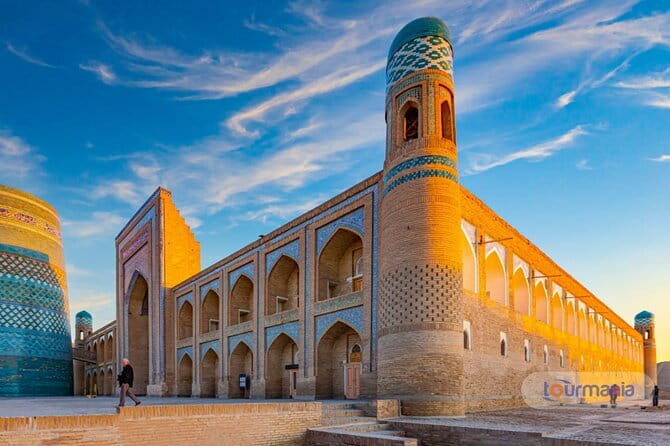
Khiva can look almost too perfect at first glance. Turquoise tile catches the sun, tall towers rise above the walls, and narrow lanes lead from one grand building to another. Without context, it is easy to admire the view but miss the connections between a ruler’s school, a saint’s shrine, a Friday mosque, and the city’s defensive core.
This tour gives you that framework in one morning or afternoon. You move through the old city on foot, stopping often enough to look closely rather than simply marching past the monuments. The guides are expected to explain the role of each building, and the strongest feedback points to clear storytelling rather than a dry list of dates.
I would especially consider this tour early in a Khiva stay. It can help you get your bearings fast, identify the buildings you want to revisit, and make later solo walks more rewarding. The end point is inside Itchan Kala, so you are already in the historic center when the guided portion finishes.
The pace should suit most people who are comfortable walking for several hours. The total schedule is about four hours, but the published stop times add up to less than that, leaving room for walking between sites, explanations, and questions. You should still plan for outdoor conditions, since the experience requires good weather.
More Walking Tours in Khiva
- Khiva: Historical City Highlights Guided Walking Tour
★ 4.8 · 156 reviews - Khiva Walking Tour
★ 4.7 · 22 reviews - Khiva Walking Tour
★ 4.5 · 15 reviews
Entering Itchan Kala, Khiva’s walled core
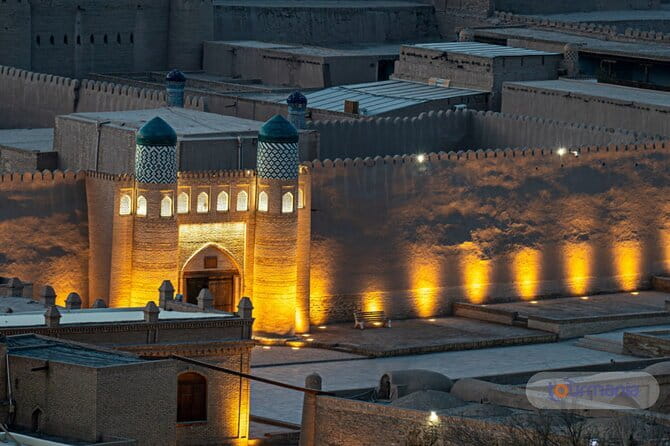
The first stop is Itchan Kala, also written as Ichan-Qala. This is Khiva’s old inner city, enclosed by historic walls and filled with many of the city’s best-known buildings. It is the setting for nearly the entire tour, not simply a quick photo stop.
The one-hour opening visit gives your guide time to explain how the old city fits together. That matters because Khiva’s most important sights are close enough to reach on foot but varied enough to blur together if you explore without a plan. Here, the city itself becomes the subject: its walls, lanes, religious buildings, schools, and royal architecture.
I like starting here because it gives the rest of the tour a clear setting. You are not looking at isolated monuments. You are learning how the major buildings share one compact urban center.
Admission to Itchan Kala is not included. The total entrance cost is listed at approximately $15, so budget for that on top of the $25 tour price. The supplied details do not give a separate breakdown of which parts of the ticket cover each building, so it is sensible to treat the quoted amount as the expected site admission rather than assuming every stop is individually free.
Islam Khoja Minaret, Khiva’s tall landmark
The Islam Khoja Minaret gets about 20 minutes, but it is one of the tour’s strongest visual moments. Located within Itchan Kala, the minaret is one of Khiva’s most recognizable structures and a useful reference point as you walk around the old city.
A guide can help you look beyond its height and color. The minaret is presented as both an architectural achievement and a symbol connected with Khiva’s religious and civic life. From ground level, you can study its shape, tile work, and place among the surrounding buildings.
The listed admission for this stop is free, though the broader Itchan Kala entrance fee remains separate. That distinction is worth keeping in mind when planning your budget.
Twenty minutes is enough for an explanation and photographs, but not a long architectural study. If the minaret is the sight you most want to examine, take note of its position and return later with more time. The guided stop is designed to give you meaning and orientation, not an extended specialist lecture.
Pakhlavon Makhmud Mausoleum and the spiritual side of Khiva
The Pakhlavon Makhmud Mausoleum introduces a different side of the city. It honors Pakhlavon Makhmud, remembered as a Sufi saint, poet, and wrestler. That combination gives the site unusual character: he is linked with religious devotion, poetry, physical strength, and local identity.
The stop lasts about 20 minutes. That is enough time for your guide to explain why the mausoleum matters and to point out its place within Khiva’s spiritual life. The building is more than another decorated monument. It represents the way a respected person can become a lasting focus for memory and devotion.
I like the change of mood here. After the grand scale of the minaret and the wider sweep of the old city, the mausoleum brings the tour closer to personal belief and cultural memory. It also helps prevent the experience from becoming only an architecture walk.
The stop is listed with free admission, while the general entrance ticket for the old city is extra. As with the other sites, you should follow the guide’s instructions about entry during the tour rather than assuming the individual listing tells the whole ticket story.
More city highlights walks in Khiva:
- Khiva: City Highlights Guided Walking Tour
★ 4.6 · 3 reviews - Samarkand: Historical City Highlights Guided Walking Tour
★ 4.8 · 153 reviews - Bukhara: Historical City Highlights Guided Walking Tour
★ 4.6 · 102 reviews - Tashkent: Historical City Highlights Guided Walking Tour
★ 4.8 · 71 reviews
Juma Mosque and its forest of wooden columns
Juma Mosque receives about 15 minutes, making it the shortest scheduled stop. Its appeal is not flashy decoration. The mosque is known for its wooden columns and a restrained design that feels quite different from Khiva’s tile-covered facades.
The mosque dates back to the 10th century, according to the supplied information, and its simple interior offers a useful contrast with the city’s more elaborate monuments. The wooden columns are the main feature to notice. They create a repeated rhythm across the prayer space and give the building a calm, almost timeless feel.
This is a place where a good explanation makes a real difference. On your own, you might see a large room with many posts. With context, you can pay attention to the building’s age, construction, purpose, and visual order.
Fifteen minutes is brief, so do not expect a long visit. Still, the stop earns its place because it changes the architectural vocabulary of the tour. You see that Khiva’s beauty is not only about turquoise surfaces and tall towers. Texture, timber, proportion, and simplicity matter too.
Allakuli Khan Madrasah and the city’s scholarly tradition
The final major stop is the Allakuli Khan Madrasah, a 19th-century educational building created under Allakuli Khan. It served as a center for Islamic learning, making it an important stop for understanding how Khiva functioned as more than a royal showpiece.
The visit lasts around 20 minutes. Your guide can explain what a madrasah was used for and how it fit into the city’s religious and educational life. That context helps you read the building as a working institution, not just a photogenic facade.
I like ending with the madrasah because it brings together several themes from the walk: power, faith, education, and architecture. The building also reinforces the idea that Itchan Kala was a complete urban center, with places for worship, study, remembrance, and government.
Again, the listed admission is free, but the approximate $15 entrance charge for the wider experience is not included. The tour ends in Itchan Kala, so you can continue looking around after the guide departs. That makes the final stop practical as well as interesting.
What the guide adds to the experience
The guide is the real variable in any history walk, and the strongest praise here is directed at the personal guiding. Iroda is singled out for being smart, kind, clear, and able to adjust explanations toward architecture and history. Another description highlights her professionalism, factual detail, and good humor.
Those qualities matter in Khiva. The city presents plenty of visual information, but dates and names alone can become a blur. You want someone who can explain why a building was made, who used it, and how it relates to the other places around it.
The feedback also points to guides answering questions willingly. That is useful if you have a particular interest in Islamic architecture, local rulers, Sufi traditions, or the practical layout of old Khiva. You should feel free to ask early in the tour so the guide can shape the explanation toward your interests.
The group limit is 15 people. That is not a private tour, but it is still a reasonable cap for a walking experience. A smaller departure can make the outing feel more relaxed, especially when the guide is explaining details inside a mosque or mausoleum. One reported group had only four people, though you should not assume every departure will be that small.
Is $25 a fair price?
At $25 per person, the tour is fairly priced if you want a structured introduction to Khiva and do not want to piece together the main sights alone. The guide, taxes, and roughly four hours of walking are included. The additional entrance charge of about $15 raises the likely total to approximately $40 per person.
That total is still reasonable for a half-day guided visit, especially if the guide is as clear and engaging as Iroda. You are paying not only to be shown the buildings, but to understand why the mausoleum, mosque, minaret, and madrasah belong in the same story.
The value is lower if you already know Khiva well or prefer to explore at your own speed. Several stops are short, and the route focuses on the essential monuments rather than allowing long independent visits at each one. In that case, you might prefer to buy the city admission and walk at your own pace.
For a first visit, I think the tour makes the most sense. It gives you a strong base, then leaves you inside Itchan Kala to return to the places that caught your eye.
Timing, meeting point, and practical details
The meeting point is the Caravan monument at 99H4+CRQ in Khiva, in the Khorezm Region of Uzbekistan. The experience ends inside Itchan Kala at Boltaeva 41, 220900, Xiva, Khorezm Region.
Check the exact map pin before setting out, since the meeting and ending points are given in different parts of the old city area. The tour does not include transportation, and the supplied details describe it as a walking experience, so plan to reach the start on your own.
You receive confirmation at booking, and a mobile ticket is available. The group can contain up to 15 people, and group discounts are offered. Most people can participate, though you should be comfortable walking for about four hours.
Good weather is required. If poor weather cancels the experience, you are offered another date or a full refund. You can also cancel for a full refund up to 24 hours before the start time. Changes or cancellations made inside that 24-hour window are not accepted, and the local time in Khiva controls the deadline.
Who should choose this Khiva walk?
I would recommend it to you if this is your first time in Khiva, you want the main sights explained in one organized route, or you enjoy architecture but prefer plain-speaking guidance over a formal lecture. It is also useful if you have limited time and want to cover the city’s essential landmarks in half a day.
The tour should suit people interested in religious buildings, old city planning, Islamic education, and local figures such as Pakhlavon Makhmud. The mix of a minaret, mosque, mausoleum, madrasah, and walled city gives you more range than a simple monument-to-monument walk.
It may be less suitable if you have mobility concerns that make several hours of walking difficult, since no special transport or accessibility details are provided. It may also disappoint you if you want long periods for photography or quiet exploration at each stop.
For families and mixed-interest groups, the guide’s clear explanations and good humor could help keep the experience approachable. The exact style will depend on the assigned guide, but Iroda’s praised approach suggests the best departures combine solid facts with a relaxed tone.
Should you book the Khiva Historical City Highlights Tour?
Book it if you want a well-organized first look at Itchan Kala and value a guide who can connect Khiva’s buildings to its religious, educational, and civic life. The strongest reasons are the focused route, the manageable four-hour length, and the reported quality of guides such as Iroda.
Before booking, add approximately $15 for entrance tickets and confirm that the walking format suits you. If you already have a strong plan for exploring Khiva on your own, the extra structure may not be needed. For most first-time visitors, though, $25 for the guide is a sensible way to turn a beautiful old city into a place you can actually understand.
FAQ
How long does the Khiva Historical City Highlights Guided Walking Tour last?
The tour lasts approximately four hours.
What sights are included?
The route includes Itchan Kala, the Islam Khoja Minaret, Pakhlavon Makhmud Mausoleum, Juma Mosque, and Allakuli Khan Madrasah.
Is the entrance fee included in the tour price?
No. Entrance tickets are not included and cost approximately $15.
What is included in the $25 price?
The price includes a professional guide and all taxes.
Where does the tour start?
The tour starts at the Caravan monument, listed at 99H4+CRQ, Khiva, Khorezm Region, Uzbekistan.
Where does the tour end?
The tour ends in Itchan Kala at Boltaeva 41, 220900, Xiva, Khorezm Region, Uzbekistan.
How many people can join the tour?
The maximum group size is 15 people.
Is the tour available with a mobile ticket?
Yes. A mobile ticket is available, and confirmation is received at the time of booking.
Can I cancel for a full refund?
Yes. You can cancel at least 24 hours before the start time for a full refund. Cancellations made less than 24 hours before the start time are not refunded.
More Historic Sites near Khiva
- Samarkand: Historical Monuments Guided Walking Tour
★ 4.8 · 446 reviews - Bukhara: Historic Center Guided Sightseeing Tour
★ 4.8 · 44 reviews - Samarkand: Historical Monuments Group Walking Tour
★ 5.0 · 29 reviews - Samarkand Historical City Highlights Guided Walking Tour
★ 5.0 · 22 reviews
Just added around Khiva
- A Night In The Kyzylkum Desert [2] From Khiva★ 4.5 · 3 reviews
- Khorezm Fortress and KyzylKum Desert Private Tour★ 5.0 · 3 reviews
- Khiva: City Highlights Guided Walking Tour★ 4.6 · 3 reviews
- Best of Khiva: Exclusive Private Tour!★ 5.0 · 3 reviews
- Khiva: classic Half-Day Tour★ 3.7 · 3 reviews
- Traditional Khiva Cooking Class with Market Visit & Lunch★ 5.0 · 4 reviews
- Master Class – Uzbek Bread (Khiva)★ 3.5 · 4 reviews
- Uzbekistan 6 Days Private Tour Khiva-Bukhara-Samarkand by Train★ 5.0 · 4 reviews
Walking Tours in Khiva, compared.
Khiva: Historical City Highlights Guided Walking Tour
Read our review →Browse the lists this tour appears in