
Reviewed · WALKING TOURS IN KHIVA
Khiva Walking Tour
Khiva’s old city packs palaces, mosques, schools, minarets, and fortress walls into a compact walk that feels more like a film set than a modern city. This private tour takes you through that remarkable core, from the western gate to the Islamkhudja complex and the Pahlavan Makhmud shrine.
I like the private format, which lets you set the start time and ask questions without keeping pace with a large group. I also like the range of sights: a khan’s harem, a columned mosque with more than 120 carved columns, a citadel tower, and Uzbekistan’s tallest minaret. The main catch is cost: $90 covers up to two people, but entrance tickets are extra at several sites.
Key points to know before you book
- Kunya Ark gives you the best early sense of Khiva’s power, with fortress buildings and a panoramic view tower.
- Tosh Hovli Palace adds palace life to the walk, including the harem, reception rooms, and a secret corridor.
- Djuma Mosque is unlike the city’s grand facades, with more than 120 carved wooden columns beneath one roof.
- Islamkhudja Minaret is the visual high point, but climbing minarets is not included.
- The route ends on a spiritual note at Pahlavan Makhmud, one of Khiva’s most important complexes.
- A private guide makes the long list of monuments easier to follow, especially if you choose French, English, German, or Russian.
Starting at Ata Darvaza, Khiva’s western gate
You meet at the ticket office by Ata Darvaza, the main western gate of the walled city. This is a useful place to begin because the gate gives you an immediate sense of Khiva’s enclosed old quarter, where many of the main sights sit within walking distance of one another.
The planned walk lasts about four and a half hours, though the stated range is four to five hours. You choose the start time when booking, and you can request a change. In summer, an early start makes good sense. Khiva can feel hot under the open sun, and the route includes plenty of courtyards and paved streets with limited shade.
The tour is private for your group, up to two people, rather than a shared outing. That matters here. Khiva’s monuments have many names and layers, and a private guide can slow down when you want more detail or move on when a room does not hold your interest.
English, Russian, French, and German are available. If you need French, guide Izzat led one especially long visit from 9:30 a.m. to 3 p.m., so you can request the language that suits you best when arranging the tour.
More Walking Tours in Khiva
- Khiva: Historical City Highlights Guided Walking Tour
★ 4.8 · 156 reviews - Khiva Historical City Highlights Guided Walking Tour
★ 5.0 · 30 reviews - Khiva Walking Tour
★ 4.5 · 15 reviews
Muhammad Amin Khan Medrese and Kalta Minor
The first major sights include Muhammad Amin Khan Medrese, described as the largest medrese in this part of Khiva, and Kalta Minor Minaret. The medrese helps you understand the scale of Khiva’s religious and educational institutions. A medrese was not simply a decorative building. It was a place connected with Islamic teaching, student rooms, and public life.
Kalta Minor is one of the city’s most recognizable markers. Its broad, unfinished form gives it a different character from the narrow, soaring minarets elsewhere in Central Asia. Your guide can place it within Khiva’s history and explain how its size and position shaped the view around the western approach.
The tour moves through several monuments in a short distance, which is one of its strengths. You are not spending the morning in a vehicle or crossing a large modern city between stops. The drawback is that the route can feel packed if you want to study every tile, doorway, and inscription. Four and a half hours is enough for an informed overview, but not a slow architectural survey of every room.
Kunya Ark, where the khan ruled
Kunya Ark is the ancient citadel and one of the most useful stops for understanding Khiva as a seat of power. Inside, the route includes the panoramic view tower, the coinage yard, and the khan’s summer and winter reception areas.
I would pay close attention to the contrast between these spaces. The reception rooms show how public business and ceremony were handled, while the coinage yard points to the practical side of government. A fortress was not only a defensive wall. It was an administrative center, royal residence, and stage for the khan’s authority.
The panoramic tower offers a strong view over the old city. From above, Khiva’s tight pattern of domes, courtyards, walls, and minarets makes more sense than it does from street level. The tower is also a reminder that Khiva is best understood as a complete walled town, not as a collection of unrelated monuments.
Entrance fees are not part of the $90 tour price. Tickets are required for the specified monuments, and there are multiple charges. You should budget for these separately before you start. The tour includes the guide, not admission to every site.
Muhammad Rahimkhan II Medrese and Djuma Mosque
Next comes Muhammad Rahimkhan II Medrese, followed by Djuma Mosque. The medrese adds another example of Khiva’s religious architecture, but Djuma Mosque gives you a very different visual experience.
Djuma Mosque is a columned prayer hall with more than 120 carved columns. Rather than relying on a grand exterior, it creates its effect through repetition, shadow, and timber detail. I like this stop because it asks you to look inward. After the bright tiled walls and tall facades outside, the mosque offers a quieter space where the columns carry the design.
Your guide is especially useful here. A hall with so many similar supports can blur together unless someone points out changes in carving, age, and arrangement. You can also ask questions about how the mosque was used and how it fits into the wider city.
Comfortable shoes are essential. The walking is not described as difficult, and the experience is wheelchair accessible, but you are still moving through a historic center for several hours. Wear clothes that are comfortable and suitable for entering religious and historic sites. Smoking is not allowed indoors.
Same city, a completely different day out:
- Transfer: Bukhara – Khiva via Ancient Fortresses
★ 4.5 · 101 reviews - Daytrip From Khiva To Ancient Fortresses
★ 4.6 · 60 reviews - Ayazkala, Toprakkala & Kizilkala Fortress Tour From Khiva
★ 4.3 · 33 reviews - Aral Sea Adventures (2 day)
★ 5.0 · 30 reviews
Tosh Hovli Palace and the khan’s private world
Tosh Hovli Palace is one of the route’s strongest stops. It was the second khan’s palace and includes the harem, summer and winter reception rooms, a secret corridor, and a special reception area.
The palace helps you see a side of Khiva that public monuments cannot show. The harem points to the private court, while the reception rooms reveal the formal side of royal life. The secret corridor adds a small touch of palace intrigue, but its real value is practical: it shows how movement, privacy, and access were managed inside the compound.
The palace also has a gift carriage associated with Tsar Alexander III. That detail connects Khiva to the wider political world beyond its walls. It is easy to think of the old city as sealed off from outside events, but objects like this point to diplomatic contact and changing regional power.
Take your time here if palace architecture interests you. At the same time, remember that the $90 covers a guided visit rather than every admission fee. If you are traveling on a tight budget, ask your guide which interiors are most important before purchasing all available tickets.
Medreses, East Gates, and a glimpse of changing Khiva
The walk continues to Kutlug Murad Medrese, now associated with a museum of surrealist paintings. This is an unusual change of pace. After rooms tied to khans, worship, and traditional education, modern artistic work brings a later chapter into the old buildings.
You also pass Allakulikhan Medrese and continue toward the East Gates, the Said Niyaz Mosque, and its medrese. These stops help fill in the shape of the old city. Khiva’s identity does not rest on one palace or one minaret. It comes from the way religious schools, mosques, royal quarters, markets, and gates work together inside the walls.
This is where a guide earns the fee. Without context, a row of medreses can become a long series of similar facades. With a guide, you can sort out which buildings served education, worship, royal life, or later museum use. A French-speaking guide such as Izzat can also make a major difference if French is your strongest language.
The route is described as wheelchair accessible, but the information does not give details about every surface, threshold, or interior passage. If you use a wheelchair, it would be wise to confirm which courtyards, towers, and palace rooms are accessible before booking.
Islamkhudja Minaret, Khiva’s defining view
The Islamkhudja complex is one of the final major sections of the walk and is presented as a symbol of Khiva. It includes a medrese, a museum of applied art, and Islamkhudja Minaret, the tallest minaret in the region and the tallest in Uzbekistan according to the tour details.
The minaret is a natural high point of the route, even if you do not climb it. Its height changes the city’s outline and gives you a clear visual reference as you walk. You can see why a tall minaret carried more than decorative value. It marked a religious complex and shaped the skyline of the entire walled town.
One important limitation is easy to miss: going upstairs in the minarets is not included. The tour includes the guide, but not minaret climbs. Ask about current access and any added cost if climbing is important to you. Do not assume that seeing the tower means you will reach its top.
The Islamkhudja School is also part of the route. It was the first modern and secular school in Khiva, making it one of the most useful stops for understanding change. The old city was not frozen in a single period. This school points to new forms of education and a shift away from a purely religious curriculum.
Pahlavan Makhmud, a fitting final stop
The Pahlavan Makhmud complex is described as the cherry on the cake of the visit, and it makes a fitting final stop. The complex is important to Khiva’s spiritual and cultural life, and its setting gives the walking tour a more reflective finish after the military, royal, and educational sites.
I would save a little energy for this part. The itinerary covers many buildings, and it is tempting to treat the last complex as one more item on a long list. Instead, let your guide explain why Pahlavan Makhmud matters and how the shrine fits into local customs.
This final stop also balances the tour. Kunya Ark shows power, Tosh Hovli shows palace life, and Islamkhudja shows later modernization. Pahlavan Makhmud brings the focus back to belief, memory, and local identity.
The chance to see Khiva’s bread baked
Along the way, you might see local bread being prepared in a clay oven. This is not guaranteed. It depends on luck, but it is exactly the kind of small, everyday detail that can make a walking tour feel tied to present-day Khiva rather than only to restored monuments.
You should not book this tour solely for the bread stop. Treat it as a bonus. If the timing works, you may get a brief look at a familiar local food made in a traditional oven. If it does not, the main route still covers the city’s major sights.
What the $90 price really covers
The price is $90 per group of up to two people. For a couple, that works out to $45 each before entrance fees. For one person, it is a more expensive private experience, but you are paying for a dedicated guide and flexible timing rather than a shared group seat.
The value depends on how you use the guide. If you want only quick photographs of the main monuments, the price may feel high once tickets are added. If you want the palace rooms, mosque details, historical links, and language support explained as you go, the private format makes more sense.
Entrance tickets to all specified objects are extra, and there are multiple admissions. Personal expenses are also excluded. I would confirm the expected ticket total before setting out, especially if you plan to enter every palace, museum, medrese, and tower.
The tour offers free cancellation up to 24 hours in advance and a reserve-now, pay-later option. Those terms give you useful flexibility, but they do not reduce the separate cost of admission tickets.
Who will get the most from this walk?
I would choose this tour if you have limited time in Khiva and want one organized route through the main old-city sights. It is also a good fit if you care about context, prefer private guiding, or need English, French, German, or Russian.
It suits couples especially well because the $90 price covers two people. Families and small private groups may also like the format, though the stated price only covers up to two. The route is accessible in general terms, but anyone with mobility needs should confirm the details of towers and historic interiors.
This is less suitable if you dislike paid interiors or want to wander without a plan. The many extra tickets can add up, and the schedule is full. You will see a lot, but you may need to choose between lingering over one palace and keeping pace with the complete route.
Should you book the Khiva Walking Tour?
Book it if you want a focused introduction to Khiva’s walled center, with a private guide who can connect the buildings into one story. The strongest reasons are the range of sights, the flexible start time, the chance to choose your language, and the access to places such as Tosh Hovli Palace, Kunya Ark, Djuma Mosque, and the Islamkhudja complex.
Go in with realistic expectations. The tour does not include entrance fees or minaret climbs, and four and a half hours is a brisk amount of time for so many monuments. Start early in summer, wear good shoes, and ask for a clear ticket estimate before you go. If you do that, this is a practical and worthwhile way to get your bearings in one of Central Asia’s most distinctive old cities.
FAQ
Where does the Khiva walking tour start?
The tour starts at the ticket office by Ata Darvaza, the western main gate of Khiva.
How long does the tour last?
The stated duration is 4.5 hours, with the program described as lasting about four to five hours.
What languages are available?
The tour is available in English, Russian, French, and German.
Is the tour private?
Yes. It is a private group experience, with the listed price covering a group of up to two people.
Are entrance tickets included?
No. Entrance tickets to the specified monuments and museums are not included, and several separate admissions may be required.
Can I climb the minarets?
Going upstairs in the minarets is not included in the tour.
What should I bring?
Bring comfortable shoes and comfortable clothes. Smoking is not allowed indoors.
Just added around Khiva
- A Night In The Kyzylkum Desert [2] From Khiva★ 4.5 · 3 reviews
- Khorezm Fortress and KyzylKum Desert Private Tour★ 5.0 · 3 reviews
- Khiva: City Highlights Guided Walking Tour★ 4.6 · 3 reviews
- Best of Khiva: Exclusive Private Tour!★ 5.0 · 3 reviews
- Khiva: classic Half-Day Tour★ 3.7 · 3 reviews
- Traditional Khiva Cooking Class with Market Visit & Lunch★ 5.0 · 4 reviews
- Master Class – Uzbek Bread (Khiva)★ 3.5 · 4 reviews
- Uzbekistan 6 Days Private Tour Khiva-Bukhara-Samarkand by Train★ 5.0 · 4 reviews
Walking Tours in Khiva, compared.
Khiva: Historical City Highlights Guided Walking Tour
Read our review →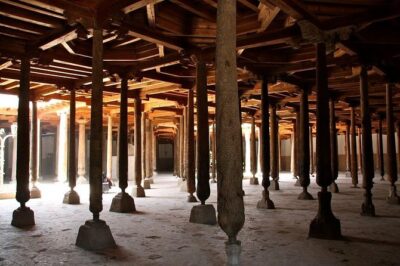
Browse the lists this tour appears in