
Reviewed · ARAL SEA & MUYNAK EXPEDITIONS
2 Days Private Tour To Aral Sea from Nukus.
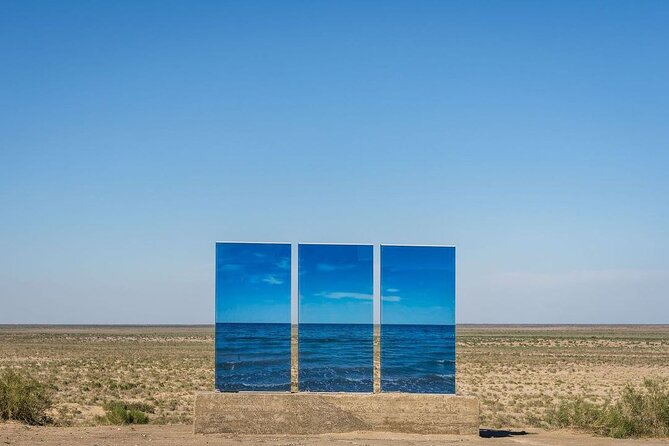
The most striking part of this two-day Aral Sea tour is the long drive across land that used to be underwater. From Nukus, you pass old Silk Road districts, the abandoned ships of Moynak, drilling towers, shells, salt flats, and the stark Ustyurt Plateau before spending the night in a yurt near the remaining sea.
I like the combination of environmental history and local life, especially the Moynak museum and ship cemetery followed by a stay at Besqala Yurt Camp. I also like that this is a private trip with an air-conditioned 4×4, rather than a large bus excursion. The drawback is the travel time: half the route has no mobile service, and the desert roads and long drives demand patience.
Key points at a glance
- The ship cemetery in Moynak: See rusting vessels stranded far from the water and visit the local museum and documentary screening.
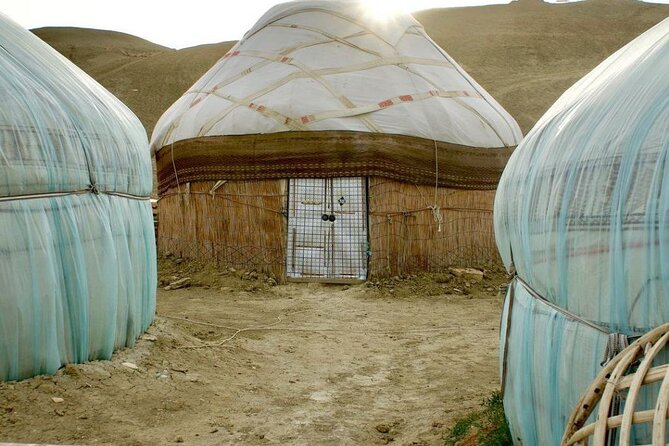
- A night beside the Aral Sea: Sleep in a yurt at Besqala Yurt Camp, with dinner, breakfast, and time to walk, collect shells, or swim.
- A genuine desert crossing: Travel over the dried seabed, where shells and gas-drilling towers help explain the region’s changing economy.
- Ustyurt Plateau history: Visit Kurgancha Kala, a 13th-century caravanserai hidden among the plateau hills.
- Remote Karakalpakstan: Pass Kubla Ustyurt village, where local people keep camels, before returning through Kungrad.
- A private format: Your group travels alone, with an English-speaking guide available if you select that option.
Why the Aral Sea journey matters
The Aral Sea is not simply a scenic destination. It is one of the clearest places in Central Asia to see how environmental decisions can reshape an entire region. Water once covered areas that are now crossed by road. Fishing towns lost their waterfront, ships were left stranded, and local life changed with the retreating water.
This tour lets you see those changes in sequence. You begin in Nukus, pass through places connected with the old Silk Road, reach Moynak and its ships, then continue onto the dried seabed. The story becomes physical. You are not just hearing that the sea disappeared. You are standing where water used to be.
The experience is best for you if you want context as well as photographs. The setting can look surreal, but the museum, documentary, ruins, villages, and conversations with your guide give the scenery meaning.
More Aral Sea and Muynak expeditions:
- Daytrip from Khiva to Aral Sea Cemetery of Ships. All in one
★ 4.3 · 52 reviews - Muynak Ship Cemetery Tour From Nukus
★ 4.3 · 32 reviews - Aral Sea Adventures (2 day)
★ 5.0 · 30 reviews
Leaving Nukus for Kungrad and Moynak
Your driver meets you in Nukus and takes you north toward the Aral Sea and Ustyurt Plateau. The first part of the trip passes through Khojely and Kungrad districts, both described as trading centers during the Great Silk Road period.
The stop in Kungrad is short, about 30 minutes, and there is no admission charge. Do not expect a full guided city visit here. It works more as a pause and a reminder that this route once connected trading communities across a much busier network.
The road then continues to Moynak, the former port town that has become the main gateway to the Aral Sea’s environmental story. This is where the tour shifts from a long road journey to a more focused historical visit.
Moynak’s ships and the vanished waterfront
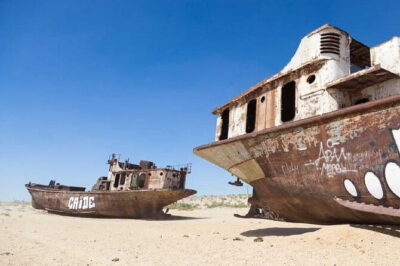
Allow about two hours in Moynak for the ship cemetery, local museum, and a short documentary about the town’s past. The ships are the most immediate image of the Aral Sea crisis. Their hulls sit on dry ground, far from any working harbor, turning a complicated environmental problem into something you can see at a glance.
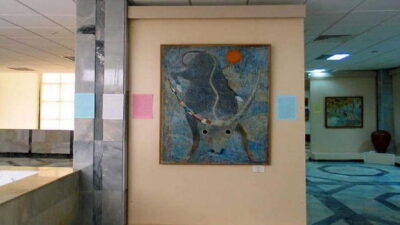
The museum adds needed background. Without it, the ship cemetery can feel like a collection of unusual objects. With the museum and film, you get a clearer sense of Moynak’s former connection to fishing and the sea.
I would give this stop your full attention rather than rushing through it for pictures. The documentary is short, but it helps connect the town’s past with what you see later on the dried seabed.
Moynak is also one of the last practical places to make phone calls and send messages. The tour information warns that much of the route ahead has no mobile or internet service because there are no settlements. YUSELL SIM cards may work in some areas, but you should not count on a signal.
Crossing the dried seabed to Besqala Yurt Camp
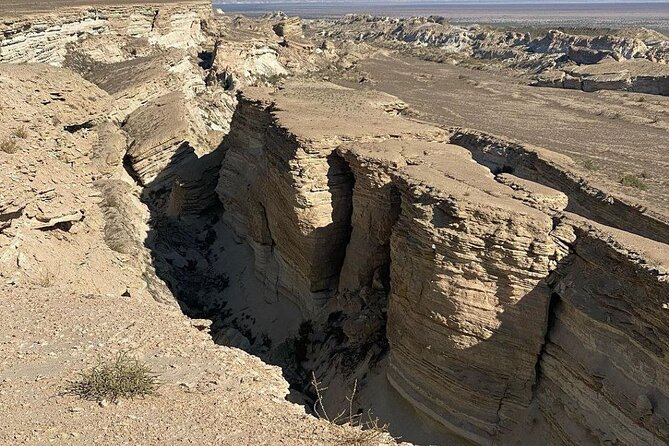
After Moynak, the route heads across the former seabed toward the Aral Sea. This is one of the tour’s most unusual sections. You may stop to photograph dried shells and other traces of the old shoreline, while drilling towers rise from the flat desert like metal trees.
The towers are a reminder that the area is not frozen in the past. Gas extraction and other industrial activity continue across this dry region. The drive therefore shows both environmental loss and the economic pressures that remain.
The exact road conditions and driving pace are not specified, so you should expect the journey to feel remote and demanding rather than polished. The air-conditioned 4×4 matters here. It provides a more suitable vehicle for the route than an ordinary city car, and the private arrangement lets your group stop for photographs according to the schedule.
At Besqala Yurt Camp, you leave your luggage in your yurt and drive down toward the sea. You have about two hours by the water for a walk, shell collecting, or a swim. The remaining Aral Sea is not a conventional beach resort, so treat this as a rare chance to experience the area, not as a developed seaside holiday.
Dinner is served at the camp. After dark, the open setting offers a chance to look at the stars and enjoy the quiet. Bring warm layers if you are sensitive to night-time cold, though the supplied information does not give a seasonal temperature range. The useful advice is simple: dress for a desert night, not only for the daytime sun.
A few more Uzbekistan days to weigh up
- From Bukhara: 2-Day Desert Yurt Camp Tour
★ 4.5 · 57 reviews - 2 Days Tour to Bukhara and Samarkand from Tashkent by train
★ 5.0 · 53 reviews - Fergana – Golden Valley From Tashkent 1 night / 2 days
★ 4.5 · 41 reviews - Yurt stay and Hiking in the Nurata Mountains tour – 2 days
★ 5.0 · 35 reviews
One night in a yurt
The yurt stay is more than a place to sleep. It breaks up a very long route and gives you a night in the region rather than a quick drive in and out. One night at Besqala is included, along with dinner and breakfast.
You should keep expectations practical. This is a remote desert camp, not a full-service hotel. The listing does not specify bathroom arrangements, heating, bedding details, or electricity, so ask the operator before booking if those points matter to you.
The camp does provide the main comforts needed for this short trip: shelter, a meal, breakfast, and a base near the sea. I like this part of the plan because it gives the Aral Sea time to register. You see the ships and museum on day one, then spend the night close to the remaining water instead of returning immediately to Nukus.
Food restrictions and allergies should be reported in advance. The tour provider says meals can be prepared according to your instructions. Lunch is included only if that option is selected, so check exactly which package you are booking.
Ustyurt Plateau and Kurgancha Kala on day two
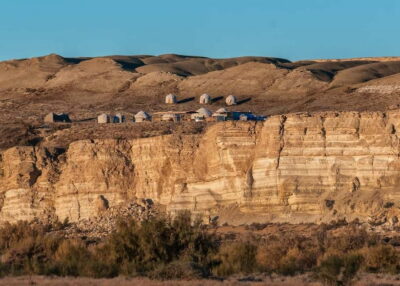
The second morning takes you onto the Ustyurt Plateau, a broad, dry region marked by hills and open space. The route includes Kurgancha Kala, a 13th-century caravanserai hidden among the hills.
A caravanserai was a stopping place for people and goods moving along long-distance trade routes. Kurgancha Kala helps show that this seemingly empty country was once part of a system of travel, exchange, and protection. It also gives the second day a different focus from the Aral Sea. Day one is about a vanished body of water and modern environmental change. Day two turns toward older movement across Central Asia.
The visit lasts about two hours and has no listed admission charge. Wear shoes with a firm sole. You will be in dry, open country around ruins rather than on a smooth museum path.
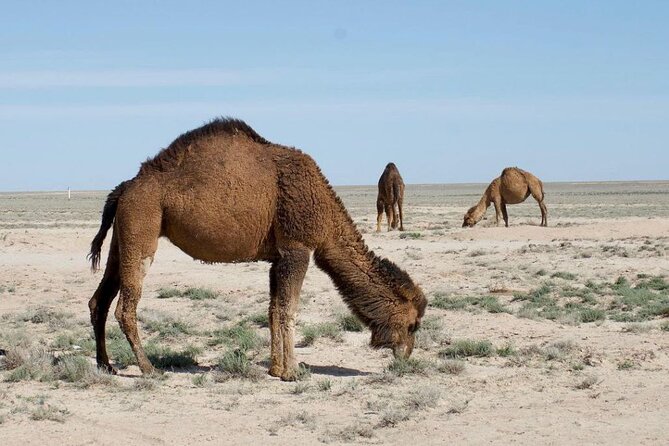
The tour also passes Kubla Ustyurt village, described as one of the region’s remote settlements. Local people keep camels there. This is a small detail, but it helps you understand how people continue to live in a place that can seem empty from the road.
Do not expect a long village program or a formal camel activity. The information only says that the route passes the village and gives you a glimpse of local life. That is still worthwhile, especially if you prefer ordinary regional details to staged entertainment.
Returning through Kungrad and Mizdakhan
The route returns through the Kungrad district for lunch at a local cafe. Lunch is a useful practical stop after the remote desert section, but remember to confirm that lunch is part of your chosen option.
The day then continues to the Mizdakhan architectural complex. The site includes the Halifa Erejep mausoleum, dated to the 12th century, the Nazlumhansuluw mausoleum from the 12th to 14th centuries, Shamun Nabi from the 19th century, and the ruins of Gaur Kala.
This cluster gives the trip a strong historical finish. You see the area not only as a place affected by the retreat of the sea, but also as a region with older religious and architectural sites. The different dates also show that this has been a settled and culturally important part of Central Asia for centuries.
Allow about two hours here. The supplied details do not provide a full description of the monuments or the walking surface, so comfortable closed shoes are the safest choice. After Mizdakhan, you return to Nukus and the tour ends.
What the $315 price really includes
At $315 per person, the price needs to be judged against the scale of the trip. You are paying for two days, a private air-conditioned 4×4, one night in a yurt, entrance tickets to the listed museums and monuments, dinner, breakfast, and an English-speaking guide if you choose that option.
That is a reasonable package for a remote route with private transport, but the final value depends on group size and selected options. The tour is private, yet the listed price is per person. A larger private group may make the cost easier to justify, while a solo booking will feel more expensive.
Lunch is listed as included if the option is selected, not automatically in every package. Insurance and personal expenses are not included. Before paying, check whether your booking includes the English-speaking guide and both lunches, as these affect the practical value.
The private format is a real advantage. You do not have to fit into a large group’s pace, and your own vehicle is better suited to the route. Still, private does not mean short or easy. You will spend substantial time on the road, and there is no mobile connection for roughly half the journey.
Comfort, clothing, and desert preparation
The operator recommends comfortable closed shoes and clothes made from natural fabrics. That advice fits the route. You will move between museum visits, ruins, a yurt camp, the dried seabed, and open plateau terrain.
Karakalpakstan is sunny for much of the year. Pack sunglasses, a hat, sunscreen, lip balm, and moisturizer. The wind and dry air can be hard on exposed skin even when the temperature feels manageable.
A small day bag is useful for water, sun protection, medication, and anything you need while your main luggage stays at the yurt. The supplied details do not state a luggage limit, so ask if you plan to bring large bags.
Food needs should be communicated before departure. The provider says it can prepare meals according to food restrictions or allergies. Do not wait until dinner at camp to explain a serious allergy.
The tour is described as suitable for most people, but that does not remove the need for self-assessment. Long vehicle rides, desert walking, ruins, and limited communications are part of the experience. If you need detailed accessibility information, ask before booking because the available description does not provide it.
Who will enjoy this tour most
I would recommend this trip to you if you want to understand the Aral Sea through several angles: environmental change, Soviet-era decline, Silk Road routes, modern desert industry, and continuing local life.
It suits photographers, history fans, geography enthusiasts, and people who prefer unusual destinations to standard city sightseeing. The ship cemetery and dried seabed offer powerful images, but the yurt night and Ustyurt villages add a human scale.
It is less suitable if you want a relaxed holiday with short transfers, reliable internet, or polished resort facilities. The tour has a 5.0 rating from four submitted reviews, with particular praise for the organization, the guide and driver, comfortable travel, and the spectacular setting. That is encouraging, but four reviews are still a small sample, so I would treat the rating as a useful signal rather than a guarantee.
Booking and cancellation details
Confirmation is provided at booking, and this is a private activity for your group only. Pickup is offered, and group discounts are available.
Free cancellation applies when you cancel at least 24 hours before the local start time. Cancellations or changes made less than 24 hours before departure are not accepted for a refund.
Because the tour averages being booked 56 days ahead, reserve early if your Uzbekistan route has fixed dates. The remote yurt camp and private vehicle make last-minute availability less certain, although the available information does not promise that dates will sell out.
Should you book the Aral Sea tour from Nukus?
Book it if you want a serious two-day excursion into a place shaped by environmental loss and long-distance history. The strongest parts are the sequence of Moynak, the ship cemetery, the dried seabed, Besqala Yurt Camp, Kurgancha Kala, and Mizdakhan. You get far more than a single photo stop.
The main question is not the price. It is whether you are comfortable with long drives, rougher desert conditions, weak communications, and simple overnight accommodation. If you are, the private 4×4, included yurt night, meals, entrance tickets, and flexible group format make the $315 price a fair way to reach a difficult destination.
Confirm your guide, lunch arrangements, and yurt facilities before booking. Then pack sun protection, closed shoes, and patience. For the right kind of explorer, this is one of the most memorable ways to see northern Uzbekistan.
FAQ
Where does the tour begin and end?
The tour begins with pickup in Nukus and ends with your arrival back in Nukus on the second day.
How long is the tour?
The experience lasts approximately two days.
Is the tour private?
Yes. Only your group participates in the activity.
Is an English-speaking guide included?
An English-speaking guide is available if you select that option when booking.
Where do you stay overnight?
You spend one night at Besqala Yurt Camp near the Aral Sea.
Are meals included?
One dinner and one breakfast are included. Two lunches are included if that option is selected.
Will I have mobile and internet service throughout the trip?
No. You are without mobile communications and internet for about half of the route because it passes through desert areas without settlements. YUSELL SIM cards may work in some places.
Just added around Uzbekistan
- Bird Watching Tours in Samarkand★ 3.6 · 3 reviews
- Tashkent Mountain Tour Amirsoy with Transport★ 3.5 · 3 reviews
- Aral Sea One Day Trip from Nukus.★ 4.0 · 3 reviews
- Bukhara: City Highlights Guided Tour with Pickup★ 5.0 · 3 reviews
- Seven Lakes Panjakent: One-Day Adventure from Samarkand★ 5.0 · 3 reviews
- Khorezm Fortress and KyzylKum Desert Private Tour★ 5.0 · 3 reviews
- A Night In The Kyzylkum Desert [2] From Khiva★ 4.5 · 3 reviews
- Ancient and Modern tour in Samarkand with Transport★ 5.0 · 3 reviews
Aral Sea & Muynak Expeditions, compared.
Daytrip from Khiva to Aral Sea Cemetery of Ships. All in one
Read our review →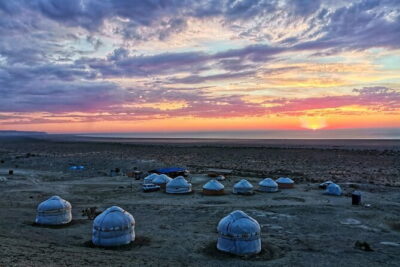
Daytrip From Khiva to Savitsky Museum & Mizdakhan & Chilpik
Read our review →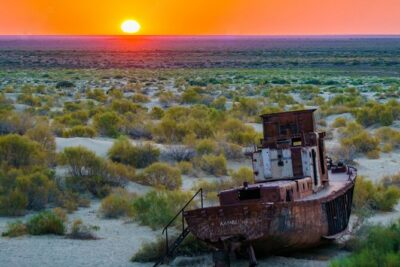
Browse the lists this tour appears in