
Reviewed · TASHKENT TOURS
Uzbekistan 8 Days Private Tour Tashkent-Urgench-Bukhara-Samarkand-Tashkent
Khiva’s walled old town is the star here. Inside Itchan Kala, blue tile, carved wooden columns, minarets, mosques, and palace courtyards sit within a compact historic center that you can explore on foot. This eight-day private trip then links Khiva with Bukhara and Samarkand, the great Silk Road cities of Uzbekistan.
I like two things right away: the private format, which keeps the pace and questions in your hands, and the practical transport plan, using the Khiva to Bukhara train and high-speed trains between Bukhara, Samarkand, and Tashkent. The main consideration is the schedule. You cover four major cities in eight days, with a domestic flight and long train rides, so this is an efficient introduction rather than a slow stay in each place.
Key points to know before booking
- Khiva’s Itchan Kala is the visual high point, with Kalta Minor, Juma Mosque, Kunya Ark, Tash Khauli Palace, and the Islam Khodja complex close together.
- A private guide travels with your group in each city, with guides associated with the tour including Tulkin in Khiva, Behrus in Bukhara, Jusra in Samarkand, and Nusrat in Tashkent.
- Train travel does much of the heavy lifting, including the Khiva to Bukhara route and high-speed services from Bukhara to Samarkand and Samarkand to Tashkent.
- Free time is built in, with an open half day in Bukhara and another in Samarkand for rest or optional sightseeing.
- The $975 price covers many costly basics, including six hotel nights, breakfasts, guides, transport, and entrance tickets, but not the Tashkent to Urgench flight.
- The tour suits curious, active sightseers, but the tight routing may feel demanding if you prefer long, unplanned stays.
Why this route works for an eight-day visit
Uzbekistan rewards a route that follows its main historic cities. Tashkent gives you a modern capital and a useful first look at the country. Khiva offers the most concentrated old town. Bukhara brings trading domes, religious buildings, and a lived-in central square. Samarkand finishes with the grand monuments of the Timurid era.
You do not waste much time returning over the same roads. After Tashkent, you fly west to Urgench, transfer to Khiva, take a train to Bukhara, continue by high-speed train to Samarkand, then return to Tashkent by rail. That arrangement is one of the strongest parts of the trip.
The private setup also matters. You travel with only your own party and a guide, rather than joining a large coach group. That makes it easier to ask about architecture, religion, local customs, or daily life, and it gives the guide some room to adjust the pace.
The tour has earned a 4.7 rating from 38 published ratings, with 97 percent recommending it. The strongest praise centers on organization, helpful drivers, centrally placed hotels, and the quality of the city guides. Those details matter more here than flashy extras because the trip has several handoffs between airports, stations, hotels, and guides.
A few more Tashkent days to weigh up
- Best of Tashkent Mountains: Amirsoy, Chimgan & Charvak Trip
★ 4.8 · 567 reviews - Samarkand One Day Tour – Departure From Tashkent
★ 5.0 · 313 reviews - Samarkand One-Day Tour Departure from Tashkent
★ 4.7 · 171 reviews
Day 1: A simple arrival in Tashkent
The first day is deliberately light. A driver meets you at the airport arrival hall with a name sign and takes you to your hotel. There is no sightseeing listed, which is sensible after an international flight.
You get a chance to settle in, exchange money if needed, and prepare for an early start. Since the tour’s listed start time is 8:00 in the morning, check your arrival schedule carefully. If you land late, the first full day may feel demanding.
The hotels are described as centrally located, high-rated 3 to 4-star or boutique properties. Six twin-room nights are included. If you want a single room, the supplement is listed as $20 per night, though you should confirm the exact number of nights included because the eight-day schedule and the six-night allowance do not perfectly match on paper.
Day 2: Tashkent’s theater, old quarter, and elegant metro
Tashkent’s sightseeing begins with the Alisher Navoiy Theater, designed by Alexey Shchusev and built between 1942 and 1947. The exterior and interior give you a glimpse of Soviet-era civic design, and the building was created in connection with the 500th anniversary of the poet Alisher Navoi.
The tour then moves to the Hazrati Imam ensemble, the spiritual center of Tashkent’s old city. The complex includes the Tillya Sheikh Mosque and other religious buildings. Allow about an hour here, since the site is more than a quick photo stop.
Amir Timur Square offers a change of pace. It is a green central space with flowers, fountains, and a statue of Tamerlane on horseback. The visit is scheduled for about 30 minutes, enough for a look around rather than a long pause.
At the State Museum of History of Uzbekistan, you get a broad introduction to the country’s past. Founded in 1876, it is one of the oldest museums in Central Asia. This is useful early in the trip because later guides can place the monuments of Khiva, Bukhara, and Samarkand into a wider regional story.
The Tashkent Metro is another smart inclusion. Opened in 1977 as the first underground system in Central Asia, it is known for stations with different designs using marble, granite, columns, and colorful relief work. The planned visit lasts about 30 minutes, so expect a short architectural tour rather than an extended ride across the city.
After sightseeing, you transfer to the airport and fly to Urgench. The domestic flight is not included in the $975 price and is listed as starting at about $50. From Urgench, a driver takes you to your hotel in Khiva.
Day 3: Khiva and the blue-tiled heart of Itchan Kala
Khiva is the place where this itinerary feels most concentrated. Itchan Kala, the walled inner town, covers about 26 hectares and forms a compact rectangle. Most of the major sights are close enough to connect on foot, which gives the day a clear rhythm.
Kalta Minor is impossible to miss. The minaret was commissioned in 1851 but left unfinished, and its surface is covered with glazed tile and majolica. Its broad, truncated shape makes it different from the tall, slender towers you see elsewhere in Central Asia.
Kunya Ark, the old citadel, occupies a central position against the western wall of Itchan Kala. It was a fortified seat of power, and the visit helps explain how Khiva functioned as more than a collection of beautiful façades.
The Pahlavan Mahmud Mausoleum brings a quieter, more personal side of the city. Pahlavan Mahmud was a poet, philosopher, and local hero associated with strength and healing. Religious sites such as this one require respectful clothing and a calm approach.
Juma Mosque is one of Khiva’s most memorable interiors. Its roof is supported by 64 hand-carved wooden columns, each with its own design. This is the sort of place where a guide earns their keep, since the visual effect is easy to admire but the construction and purpose deserve explanation.
The Islam Khodja complex includes a madrasa and minaret in the southeastern part of the old town. Tash Khauli Palace, built between 1830 and 1838 for Allakuli Khan, shows another side of Khorezm architecture through its courtyards and decorative tilework.
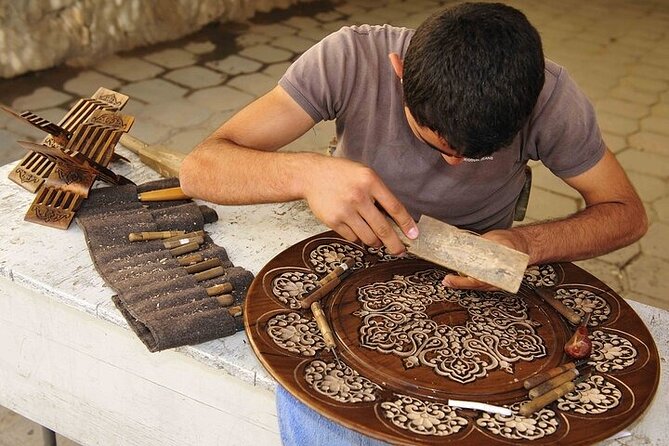
A visit to the Khiva silk workshop adds a local craft element. The community-supported workshop is run by local women who design and hand-weave silk carpets. It is a pleasant counterweight to the monumental buildings, though you should treat any shopping time as part of the visit rather than assuming it is entirely free exploration.
The day ends with a train from Khiva toward Bukhara. The listed departures are either 3:00 pm to 9:00 pm or 6:00 pm to midnight, depending on the service. That is a long ride after a full day of sightseeing, so pack water, keep your day bag light, and confirm the exact train time before departure.
Same city, a completely different day out:
- Tashkent: Amirsoy Resort, Chimgan Mountain and Charvak Lake
★ 4.8 · 170 reviews - From Tashkent: Sightseeing Day Trip to Khujand, Tajikistan
★ 4.7 · 169 reviews - Explore Amirsoy, Chimgan & Charvak – A Full-Day Mountain Tour
★ 5.0 · 158 reviews - Tashkent City Tour
★ 5.0 · 121 reviews
Day 4: Bukhara’s domes, pools, and royal fortress
Bukhara feels less like a single enclosed museum and more like a historic city woven into present-day streets. The route begins at Lyab-i-Hauz, a 16th and 17th-century ensemble built around a pool. It remains a natural place to pause, and the shade and open space are welcome after several interior visits.
Poi Kalyan is the city’s great architectural marker. The Kalyan Minaret rises 45.6 meters and dates to 1127, before the Mongol conquests. The nearby mosque gives you the scale and setting needed to understand why this area was such an important religious center.
The Ark of Bukhara is a royal fortress within the city. Rulers of Bukhara used it for more than a thousand years, and its massive walls contrast nicely with the delicate tile and brickwork elsewhere in town. Set aside an hour here, since the site is broad and the story is tied closely to Bukhara’s political life.
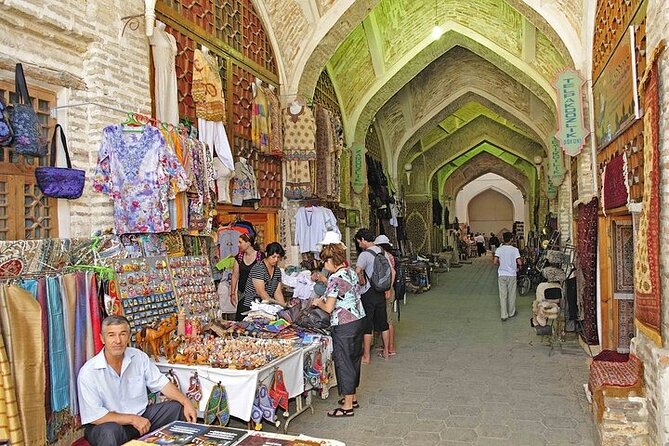
The Trading Domes are a good place to browse crafts and get a feel for Bukhara’s role as a commercial stop on the Silk Road. They are not only archaeological remains. Artisans still work in and around these covered market spaces, giving you a chance to see local products in a historic setting.
Maghak-i Attari Mosque is particularly interesting because the site is connected with earlier Buddhist and Zoroastrian use. Its brickwork rewards a close look, and it gives your guide an opportunity to explain how older religious layers remained part of the city’s story.
Bolo Hauz Mosque, opposite the Ark, completes the main Bukhara sightseeing day. Its name refers to the pool in front of it, and its position creates a strong visual relationship between mosque, water, and fortress.
The itinerary includes entrance fees to the listed sights, but photography charges are extra. Budget about $1 to $2 per site in cash where a photo fee is collected.
Day 5: Choice and a fast train to Samarkand
Bukhara’s open half day is valuable. You can rest, return to a favorite market, or arrange the optional half-day countryside outing. That excursion includes the Emir’s Summer Residence, the Bakhoutdin Naqshband Mausoleum, and the Samani Mausoleum.
This choice makes the tour more flexible than a schedule that fills every hour. If you need a slower morning, take it. If you want more context beyond the city center, the optional tour gives you a way to use the time.
In the afternoon, a transfer takes you about 15 kilometers to Kagan station. The high-speed train to Samarkand is subject to availability, so the exact departure may vary. After arriving, a driver takes you to your hotel.
This is one of the days when the private logistics help. You do not need to work out the station transfer or find your hotel after arriving in a new city. Still, the combination of free time, a transfer, and a train means you should keep valuables and essentials in your carry-on.
Day 6: Samarkand’s grandest monuments
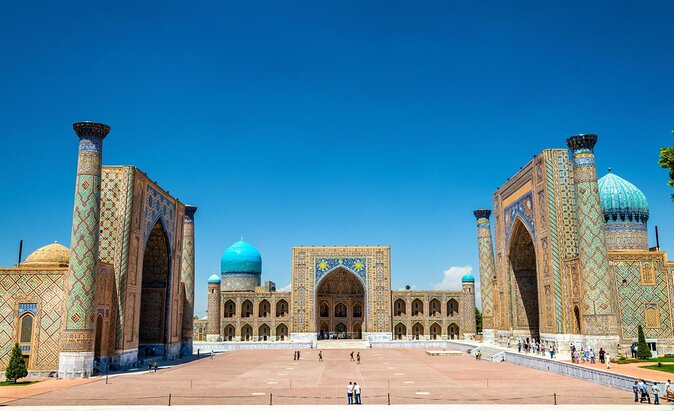
Samarkand brings a larger scale than Khiva or central Bukhara. The day starts at Registan Square, surrounded by the Ulugbek, Sherdor, and Tilla-Kori madrasas. Allow two hours. You need time to look at the tile patterns, compare the façades, and hear how the square changed over time.
Gur Emir Mausoleum is closely tied to Tamerlane, known locally as Amir Timur. The beautifully restored tomb dates to 1404 and 1405, and its decoration offers a more intimate setting than Registan’s huge open space.
Shah-i-Zinda is a sequence of tombs and mausoleums on the southeastern mound of Afrosiab. The complex includes 44 tombs across more than 20 mausoleums. It is one of the places where the details matter most, so take your time on the approach and stairways.
Bibi Khanym Mosque was built on Timur’s order between 1399 and 1404 and named for his wife. Its size and damaged, restored form give you a different view of Timurid ambition than the more polished Registan complex.
Siab Bazaar is a welcome final stop. You can see produce, local goods, and handicrafts, and it gives the day a human scale after several major monuments. It is also a useful place to browse rather than just observe.
The sightseeing is full, with roughly six hours spread across five major stops. Comfortable shoes are a must, and you will appreciate having water available. The tour includes admission tickets, but photo fees may still apply.
Day 7: Optional Samarkand sites and the return to Tashkent

Your second half day in Samarkand is open for rest or an optional tour. The proposed outing includes Ulugbek Observatory, the Afrosiyob Museum, and the Hodji Danior Mausoleum.
The observatory and museum provide a more scientific and archaeological counterpoint to the city’s mosques and tombs. If you have already had your fill of grand architecture, this is a good use of your remaining time. If you prefer an easier day, stay near the center and revisit a market or square.
In the late afternoon, you transfer to the station for the high-speed train to Tashkent. Again, service depends on availability. The three-hour ride is much easier than the Khiva to Bukhara train, and it lets you finish the route without another long road transfer.
What the $975 price really covers
At $975 per person, the tour is not a bare-bones sightseeing package. The price includes an air-conditioned vehicle, airport and station transfers, six nights in twin rooms, six breakfasts, licensed guides in each city, entrance tickets, the Khiva to Bukhara train, and high-speed trains from Bukhara to Samarkand and Samarkand to Tashkent.
It also includes visa support if needed and 24-hour customer service. The domestic Tashkent to Urgench flight is extra, starting at about $50, and tips for guides and drivers are not included. A single room costs an additional $20 per night.
The value is strongest if you would otherwise need to arrange several separate guides and transfers. The tour covers a lot of ground, and the driver waiting at each destination removes much of the uncertainty that can make a multi-city trip tiring.
It is less compelling if you already speak the local languages, prefer independent rail travel, or want to choose every hotel and sightseeing stop yourself. You are paying for coordination as much as for admission tickets.
Who should book this private Uzbekistan tour?
I would recommend it to first-time visitors who want the major Silk Road cities without managing domestic transport, station transfers, and separate local guides. Couples, families, and small groups will get the most from the private format.
It is also a good fit if you value historical explanation. The city guides named in connection with the trip include Tulkin in Khiva, Behrus in Bukhara, Jusra in Samarkand, and Nusrat in Tashkent. Their role is important because the monuments can blur together when seen quickly.
I would hesitate if you want a relaxed pace. The Khiva sightseeing day is busy, followed by a train that may run as late as midnight. The next cities are easier, but the overall route still asks you to pack and move often.
The tour is suitable for most people, and public transport is nearby in the cities. You should still be comfortable with walking through historic districts, standing at monuments, and managing several long transport days.
Practical details to settle before departure
Confirmation is provided at booking, and pickup is offered. Check your visa requirements before buying flights, since the tour provider offers visa support but does not remove your responsibility to meet entry rules.
Ask for the exact hotel list, the number of nights included, the domestic flight schedule, and the confirmed train times. The itinerary shows changing train windows and subject-to-availability high-speed services, so these details can affect how much free time you have.
Carry some small cash for photography charges. Plan on $1 to $2 per site when required, and keep a little extra for tips, since guide and driver gratuities are separate.
Free cancellation is available up to 24 hours before the local start time for a full refund. Changes or cancellations made within 24 hours are not accepted for a refund.
Should you book it?
Book this tour if you want a well-organized first visit to Uzbekistan with Khiva, Bukhara, Samarkand, and Tashkent all in one trip. The private guides, included admission fees, central hotels, and train connections make the $975 price reasonable, especially for a small group.
Skip it if you want to linger in one city, avoid early starts, or control every detail yourself. Before committing, confirm the flight and train schedules and ask how the six included hotel nights fit the eight-day plan. If those details work for you, this is a practical way to see Uzbekistan’s finest historic cities without spending your holiday on logistics.
FAQ
Is this an eight-day private tour?
Yes. The route begins with arrival in Tashkent and ends with airport transfer on Day 8. Only your private group participates.
What cities are included?
The route includes Tashkent, Khiva, Bukhara, and Samarkand. You fly from Tashkent to Urgench for the transfer to Khiva, then return to Tashkent by high-speed train from Samarkand.
Is the Tashkent to Urgench flight included?
No. The domestic airline ticket is not included and is listed as starting at $50 per ticket.
Are hotels and breakfast included?
Yes. The package includes six nights in twin rooms at centrally located 3 to 4-star or boutique hotels, plus six breakfasts. A single-room supplement of $20 per night applies.
Are entrance tickets and trains included?
Entrance tickets to the listed sights and museums are included. The Khiva to Bukhara train and high-speed trains from Bukhara to Samarkand and Samarkand to Tashkent are also included, subject to train availability where stated.
Can I cancel for a full refund?
You can cancel at least 24 hours before the experience start time for a full refund. Cancellations or changes made less than 24 hours before the local start time are not refunded or accepted.
Just added around Tashkent
- Tashkent Mountain Tour Amirsoy with Transport★ 3.5 · 3 reviews
- Tashkent: 3-Day Horseback Riding Tour in Chimgan Mountains★ 4.4 · 3 reviews
- Private Intercity Transfer Tashkent – Samarkand – Tashkent★ 3.5 · 3 reviews
- Samarkand: Uloq-Kopkari (Buzkashi) Game Day Tour★ 5.0 · 3 reviews
- Private Tashkent City Tour★ 5.0 · 3 reviews
- Transfer Tashkent Airport / Railway Station – Hotel★ 3.5 · 3 reviews
- Amirsoy & Chimgan mountain tour from Tashkent★ 5.0 · 3 reviews
- Heliocomplex “Institute of the Sun” – Remnants of USSR★ 5.0 · 3 reviews
Tashkent Tours, compared.
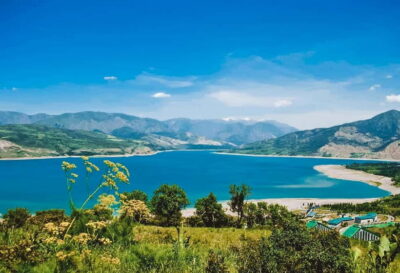
Best of Tashkent Mountains: Amirsoy, Chimgan & Charvak Trip
Read our review →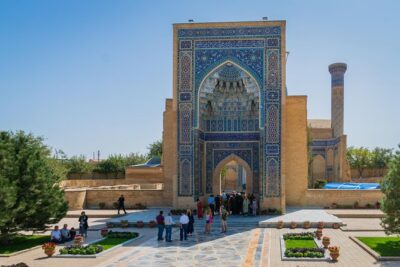
Samarkand One Day Tour – Departure From Tashkent
Read our review →Tashkent: Amirsoy Resort, Chimgan Mountain and Charvak Lake
Read our review →From Tashkent: Sightseeing Day Trip to Khujand, Tajikistan
Read our review →Explore Amirsoy, Chimgan & Charvak – A Full-Day Mountain Tour
Read our review →Tajikistan : Exclusive Seven Lakes Day Tour From Samarkand
Read our review →Explore Amirsoy, Chimgan, Charvak Adventure Tour
Read our review →
Browse the lists this tour appears in