
Reviewed · TASHKENT TOURS
Tashkent Walking Tour
Tashkent’s story comes into focus when you move from grand Soviet-era squares to the tiled domes of the old city in one long afternoon. This private tour links Amir Timur Square, the Metro, Chorsu Bazaar, and Hazrati Imam, giving you a useful first look at a city that can otherwise feel spread out and hard to read.
I like the wide historical range and the chance to ride Tashkent’s remarkable underground museum rather than simply passing it on the street. I also like the private format: guides such as Ali, Nuriddin, and Abdunazar have led this route in English, Russian, Spanish, French, and German, and can adjust the pace for questions and photographs. The main concern is reliability. One booking had no guide arrive and an invalid phone number, so confirm the meeting details before setting out.
Key points to know before you book
- Seven major stops in one half-day: You move from modern central Tashkent to its oldest market and most important Islamic complex.
- The Metro is part of the sightseeing: Allow about an hour, but bring extra money because the subway fare is not included.
- Chorsu Bazaar gives the tour its local pulse: This is the place to see food, trade, and daily life rather than only official monuments.
- The tour ends at Hazrati Imam: Plan your afternoon around the final complex, especially if you want time for its religious buildings and manuscript display.
- It is a private tour for your group: You can ask questions freely and slow down for photos, though the listed route is still a full 4 to 5 hours.
- The price is $35 per person: That covers the professional guide and taxes, but not Metro fares, entrance tickets, or personal spending.
From Amir Timur Square into modern Tashkent
Meet at the Hotel Uzbekistan on Mirzamakhmud Musakhanov Street. The opening stop, Amir Timur Square, introduces the modern city through its central public space and a changing set of national symbols.
The square once held monuments to Stalin and Marx. Today, it carries a monument to Tamerlane, known locally as Amir Timur. That change tells you a great deal about Uzbekistan’s public identity after independence. Your guide can connect the monument with the wider story of how Tashkent has presented itself over time.
The area also marks the place where the first university and bank of Central Asia were formed. You get about 30 minutes here, enough for orientation, photographs, and a short explanation without spending too long in one open square.
This is not the most intimate part of the walk. It is a formal space, and much of its appeal comes from the historical shifts it represents. I would treat it as a starting lesson rather than the main event.
More walking tours in Tashkent:
- Tashkent Walking City Tour
★ 4.5 · 70 reviews - Tashkent Walking Tour with Local Lady / Gentleman
★ 4.5 · 29 reviews - Tashkent Walking & Food Tour: Highlights + Local Flavors
★ 5.0 · 18 reviews
Broadway Alley and Tashkent’s central promenade
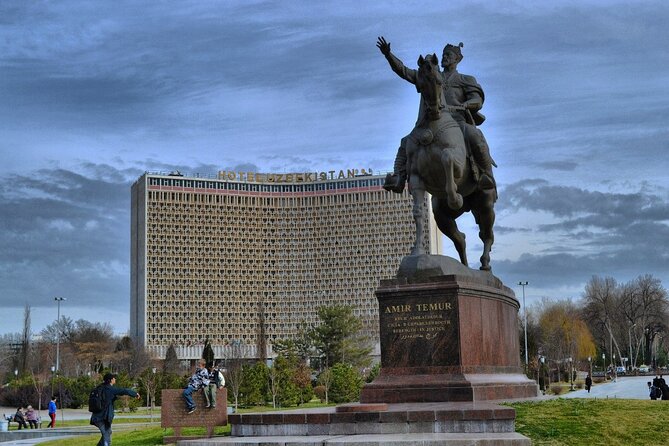
From Amir Timur Square, the route continues along Broadway Alley, or Sayilgoh. The name suggests something grander than the actual scale, but it is a useful pedestrian link through the heart of the city.
Its past is surprisingly different from its present. The area was once a swamp, later drained and turned into a leisure ground for the Tsar’s soldiers. Today, it serves as a central place for recreation and entertainment.
You have roughly 30 minutes here. That gives you time to watch city life, take pictures, and hear how the central district changed from imperial planning to a modern public promenade. The stop is less about a single building and more about understanding how Tashkent’s core was shaped.
Because the tour covers a lot of ground, do not expect a long pause at every location. If you enjoy people-watching or want more time for photographs, tell your guide early. Private touring makes that request easier than it would be in a large group.
Alisher Navoi Theater, where local craft meets European form
The Alisher Navoi Theater is one of the route’s strongest architectural stops. It is described as the first opera and ballet theater in Central Asia and remains one of Tashkent’s best-known modern landmarks.
Its design combines folk art with Neoclassicism. That blend matters. Rather than treating the theater as a purely European import, the building reflects an effort to place local decorative traditions inside a formal theater structure.
You spend about 30 minutes here, with no admission fee listed for the stop. The exterior and historical explanation are the main focus, so this is not an opera performance visit. Still, the theater gives the tour a welcome change of scale after the open squares.
I would pay attention to the decorative details and ask your guide about the local artistic elements. Guides who explain the building in context can make this short stop much more rewarding than a quick photograph outside.
Independence Square and the symbols of a new country
Independence Square, or Mustaqillik Square, is the country’s main ceremonial square. It contains the administrative offices of the Cabinet and the Senate, and it functions as a symbol of Uzbekistan’s independence.
The location also once served as an administrative center under an earlier political order. Your guide can help you read the square as more than a broad paved space. Its meaning comes from the shift in government, symbols, and public memory.
Expect about 30 minutes here. The stop is free, and the route does not list an admission visit to the government buildings. You will see the public setting and hear its background, not tour the offices themselves.
As with Amir Timur Square, this part can feel formal and spacious. That is useful if you want political and modern history, but it may feel less rewarding if you prefer markets, mosques, or ornate interiors. The tour wisely places these civic spaces before the Metro and old city, creating a clear change in mood.
A few more Tashkent days to weigh up
- Best of Tashkent Mountains: Amirsoy, Chimgan & Charvak Trip
★ 4.8 · 567 reviews - Samarkand One Day Tour – Departure From Tashkent
★ 5.0 · 313 reviews - Samarkand One-Day Tour Departure from Tashkent
★ 4.7 · 171 reviews - Tashkent: Amirsoy Resort, Chimgan Mountain and Charvak Lake
★ 4.8 · 170 reviews
One hour beneath the city in Tashkent Metro
The Tashkent Metro is the tour’s most distinctive modern sight. Opened as the first metro in Central Asia, it is known for stations with different decorative schemes. The route presents it as an underground museum, and the one-hour visit gives you time to see more than a single platform.
This is a practical sightseeing choice as well as a transport leg. Tashkent’s main sights are spread across the modern center and old city, so the Metro helps connect parts of the itinerary without turning the whole afternoon into a road transfer.
The fare is not included. Set aside money for the subway ticket, and remember that station access and the train ride form part of the tour’s cost to you. The supplied price also excludes entrance tickets and personal expenses, so $35 is not the complete out-of-pocket figure.
The Metro may be the part you remember most clearly from the modern half of the tour. Each station has its own decor, so look around before boarding rather than treating the stop as a simple ride. Your guide can point out what makes individual stations different and explain why the subway is considered one of Tashkent’s major sights.
Chorsu Bazaar, the heart of the old city
Chorsu Bazaar changes the tone of the afternoon. It is described as the oldest bazaar in Uzbekistan and the heart of the old city, a working Eastern market rather than a monument built for sightseeing.
You have about 40 minutes here. That is enough for a first walk through the market, but not necessarily enough for a slow shopping expedition. The bazaar is best approached with open eyes and a little patience. Look at the arrangement of goods, the movement of shoppers, and the way the market serves ordinary city life.
Unlike the formal squares, Chorsu gives you a direct sense of Tashkent as a lived-in place. You are not only hearing about the city’s past. You are seeing a market that still functions as part of the present city.
Your guide can help you understand what you are seeing and answer questions as you go. If you want to buy something, keep that within the 40-minute limit. The private format helps, but the final stop still takes about an hour, and the route is designed to keep moving.
Hazrati Imam, the spiritual finish
The tour ends at the Hazrati Imam, or Khasit Imam, complex, with about an hour devoted to the area. This is the route’s most important religious and architectural stop.
The complex includes the Barakhan and Tillesheyh madrassas, mosques, and a mausoleum connected with one of Tashkent’s first imams. It is also a major pilgrimage site in the city. The setting brings together religious buildings, historic architecture, and an important manuscript collection.
The most unusual detail is the chance to see one of four seventh-century manuscripts of the Holy Koran. That is a major reason to save energy for the final stop. The manuscript display gives the complex a significance beyond its tiled facades and courtyards.
Entrance fees are not included, so ask your guide what can be entered and what additional charges apply on the day. The supplied tour details do not give exact entrance prices or opening times, so you should not assume every interior is included in the $35 cost.
Ending here is sensible. The tour moves from the planned, modern center to Chorsu and then to the religious center of the old city. It leaves you in a part of Tashkent that deserves more time if your schedule allows.
How much walking should you expect?
This is called a walking tour, and you should take that seriously. One participant described walking about 10 kilometers, while the stated duration is approximately 4 to 5 hours.
That means comfortable shoes matter more than smart clothing. The route includes open squares, a pedestrian promenade, market aisles, Metro stations, and the Hazrati Imam complex. Even if the exact distance varies, you will spend much of the afternoon on your feet.
The itinerary gives 30 minutes at the first four stops, one hour for the Metro, 40 minutes at Chorsu, and one hour at Hazrati Imam. Those times add up to a demanding but logical half-day. You get broad coverage, not a slow, single-neighborhood walk.
Most people can participate, and the tour is near public transportation. Still, if you need frequent rest stops, tell the guide at the start. Private touring gives you more room to adjust than a fixed large-group schedule.
The guides and the value of a private tour
The listed guides have handled the route in several languages. Ali is noted for excellent English and strong command of the sites and regional context. Nuriddin has been described as polite and communicative, including sending an update when he was running a few minutes late. Abdunazar led the route in Spanish and was praised for patience and an easy manner.
Those details matter because this tour covers politics, architecture, religion, and daily life in a short period. A guide who can answer questions clearly will help you connect the monuments instead of simply naming them.
The private format is another advantage. Only your group participates, so you can ask why Soviet monuments disappeared, pause for a photograph, or spend a little longer at a station that catches your eye. The downside is that the quality depends heavily on the individual guide assigned that day.
At $35, the value is good if you want an efficient introduction and do not mind paying separately for Metro and entrance fees. You are paying for several hours of guiding across a wide part of the city, not merely a short stroll around a central square. Group discounts may lower the per-person cost for larger parties, though the tour remains private.
The serious practical warning is the reported missed meeting. One booking had no guide arrive, and the listed contact number was said to be invalid. That appears inconsistent with the otherwise positive experiences, but it is too important to ignore. Confirm the meeting point at Hotel Uzbekistan, the start time, and a working contact method before the day of the tour.
Who should choose this Tashkent tour?
I would recommend it to a first-time visitor who wants a strong city orientation in one afternoon. You see the modern center, a major theater, official squares, the Metro, the oldest bazaar, and the city’s key Islamic complex without having to plan several separate outings.
It also suits you if you like history explained through places. The route offers political change at the squares, architecture at the theater, public transport as art at the Metro, daily commerce at Chorsu, and religious heritage at Hazrati Imam.
It is less suitable if you want a relaxed food tour, a long shopping session, or an in-depth visit to every building. The schedule is broad, and the walking distance can be substantial. You should also budget for extra fees instead of treating $35 as the final total.
Free cancellation is available if you cancel at least 24 hours before the local start time. Changes or cancellations within 24 hours are not refunded, so check your plans before that cut-off.
Should you book the Tashkent Walking Tour?
Book it if you want coverage, context, and a private guide more than a leisurely pace. The route is unusually varied, and the Metro, Chorsu Bazaar, and Hazrati Imam give the afternoon real character.
I would be especially inclined to book with a guide who matches your language needs, then confirm the appointment directly. Ali may suit English speakers, while Abdunazar is a useful name to request if you want Spanish. The exact guide assignment is not guaranteed in the supplied details, so ask before paying if language is important.
Skip it if you already know central Tashkent well or prefer to explore slowly on your own. For a first visit, though, $35 is a fair starting point, provided you allow for Metro and entrance costs, wear good shoes, and verify that the guide and phone contact are current.
FAQ
Where does the Tashkent Walking Tour start?
The tour starts at Hotel Uzbekistan, at Mirzamakhmud Musakhanov Street 45 in Tashkent.
Where does the tour end?
The tour ends at the Hazrati Imam Complex, specifically near the Hazrati Imam Mosque on Qorasaroy ko’chasi.
How long does the tour last?
The experience lasts approximately 4 to 5 hours.
Is the tour private?
Yes. Only your group participates in the activity.
Is the Metro fare included?
No. The Tashkent Metro fare is not included in the tour price.
Are entrance tickets included?
No. Entrance tickets and other personal expenses not specified in the program are excluded.
What languages are available?
The professional guide service is listed in English, Russian, Spanish, French, and German.
Just added around Tashkent
- Tashkent Mountain Tour Amirsoy with Transport★ 3.5 · 3 reviews
- Tashkent: 3-Day Horseback Riding Tour in Chimgan Mountains★ 4.4 · 3 reviews
- Samarkand: Uloq-Kopkari (Buzkashi) Game Day Tour★ 5.0 · 3 reviews
- Private Intercity Transfer Tashkent – Samarkand – Tashkent★ 3.5 · 3 reviews
- Private Tashkent City Tour★ 5.0 · 3 reviews
- Transfer Tashkent Airport / Railway Station – Hotel★ 3.5 · 3 reviews
- Heliocomplex “Institute of the Sun” – Remnants of USSR★ 5.0 · 3 reviews
- Half-day excursion around Tashkent★ 5.0 · 3 reviews
Tashkent Tours, compared.
Best of Tashkent Mountains: Amirsoy, Chimgan & Charvak Trip
Read our review →
Samarkand One Day Tour – Departure From Tashkent
Read our review →Tashkent: Amirsoy Resort, Chimgan Mountain and Charvak Lake
Read our review →From Tashkent: Sightseeing Day Trip to Khujand, Tajikistan
Read our review →Explore Amirsoy, Chimgan & Charvak – A Full-Day Mountain Tour
Read our review →Tajikistan : Exclusive Seven Lakes Day Tour From Samarkand
Read our review →Explore Amirsoy, Chimgan, Charvak Adventure Tour
Read our review →
Browse the lists this tour appears in