
Reviewed · CITY TOURS IN SAMARKAND
Samarkand: city tour
Samarkand’s great monuments are packed into one memorable route, from the tiled schools of Registan Square to the tomb of Timur at Gur-Emir. You get a clear introduction to the city’s place on the Silk Road without having to sort out transport between far-flung sights.
I like the small-group format, which gives your guide room to answer questions, and I like the human touch promised by guides such as Amin and Umid. One thing to weigh is the price: at $85 per person, entrance fees and meals are extra, so the value depends on how much you want guided context and door-to-door transport.
Key points at a glance
- Registan Square opens the tour: See the Ulugh Beg, Sher-Dor, and Tilya-Kori madrasahs together in Samarkand’s most famous setting.
- Four major landmarks fit into one route: The plan includes Registan, Bibi-Khanym Mosque, Shahi-Zinda, and Gur-Emir.
- Amin and Umid are named guide options: Amin is noted for wit, while Umid has helped with station pickup and transport arrangements.
- Transport is included: You are taken between the included landmarks, saving time and energy in a spread-out historic city.
- Entrance tickets are extra: Budget separately for admission to the sights, as well as any food.
- The tour suits mobile sightseers: It is not suitable for wheelchair users, babies under one year, or people over 95.
Why this Samarkand route works
Samarkand can feel like a history book written in blue tile. The main monuments are famous, but their scale and setting make more sense when you know what you are looking at. This tour gives you that framework in one outing, with an expert guide explaining the buildings, rulers, scholars, and religious traditions tied to each stop.
The route also has a sensible shape. Registan gives you the grand civic view first. Bibi-Khanym then shows the ambition of Timur’s building program, Shahi-Zinda brings you into a quieter lane of mausoleums, and Gur-Emir closes with the burial place of Timur and his family.
I would choose this tour if you have limited time in Samarkand or want a strong first look before exploring on your own. You get transportation to the included sights and a small group rather than a large procession. That matters here, since tilework and inscriptions are easy to miss when a guide has to speak over a crowd.
The $85 cost is not a bargain-basement sightseeing price. Since admission and meals are not included, you should calculate the full day’s cost before booking. Still, the price can make sense if you value a private-feeling group, an English- or Russian-speaking guide, and help connecting four important places without arranging separate rides.
More City Tours in Samarkand
- Samarkand: Historical City Highlights Guided Walking Tour
★ 4.8 · 153 reviews - Private Samarkand City Tour With Transportation
★ 5.0 · 149 reviews - A City Tour Of Samarkand: The Pearl Of The East
★ 5.0 · 133 reviews
Registan Square and its three madrasahs
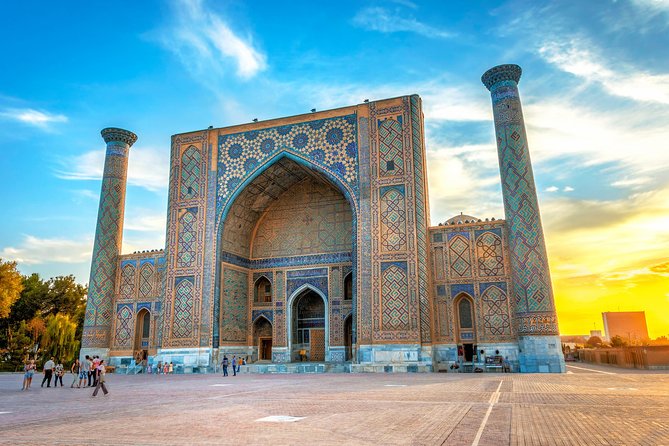
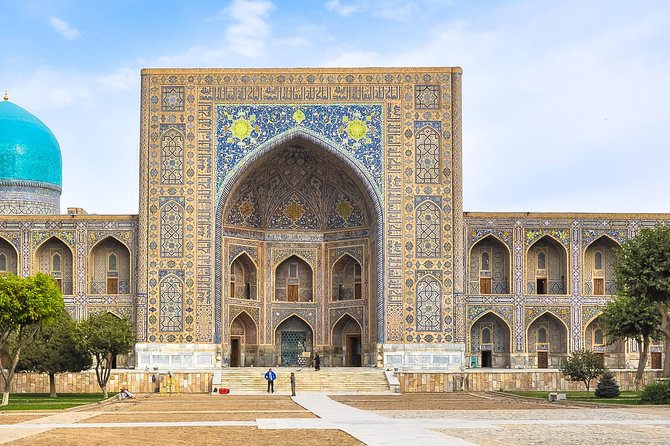
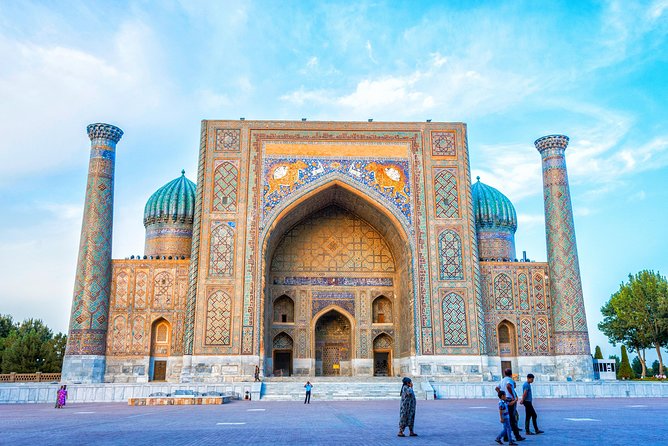
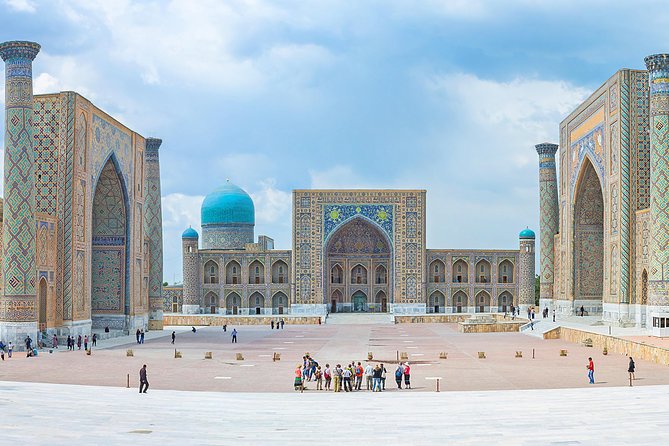
Registan Square is the natural starting point. This broad public space is framed by three monumental religious schools, called madrasahs: Ulugh Beg Madrasah, Sher-Dor Madrasah, and Tilya-Kori Madrasah.
You will first notice the scale. The buildings do not merely decorate the square. They define it, with tall entrance portals, patterned façades, and domes that pull your eyes upward. Your guide can help you read the differences between the three structures instead of treating them as one giant photo stop.
Ulugh Beg Madrasah connects the square with scholarship. Ulugh Beg was both a ruler and an astronomer, and the building recalls Samarkand’s role as a center of study. This is one of the best places to listen closely to the guide, since the site means more when you understand that religious education and scientific work both mattered here.
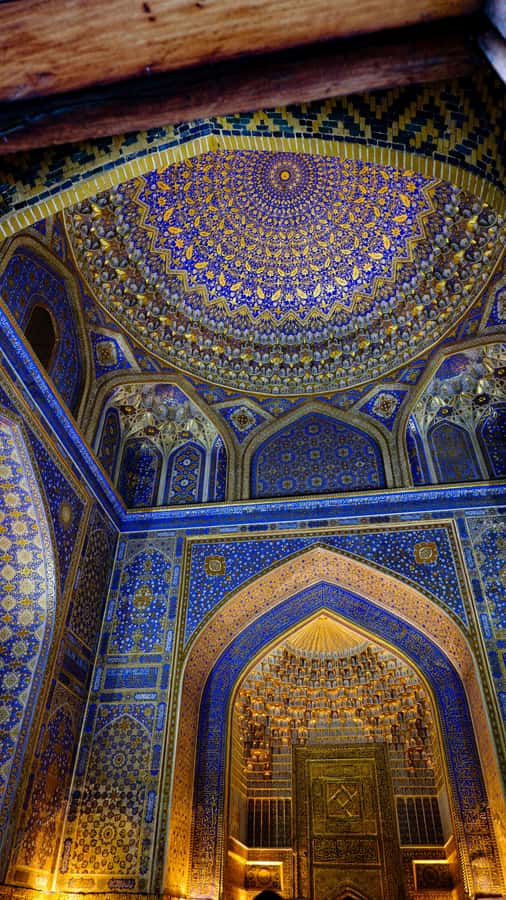
Sher-Dor is known for its striking entrance decoration. Tilya-Kori completes the trio and is especially important for its interior ornament. Exact access and viewing conditions can vary, so I would not count on seeing every corner in the same way on every visit.
Take a moment to look across the square before rushing toward the next stop. The three façades were designed to be read together, and the full effect is much stronger from a distance than in a series of close-up photographs.
A guide such as Amin may add humor to the architectural explanation. That can be useful during a stop filled with dates and rulers. His appeal, according to the available feedback, comes from making the information feel lively rather than turning the square into a lecture.
Bibi-Khanym Mosque and Timur’s ambition
From Registan, the tour continues to Bibi-Khanym Mosque, one of the city’s most imposing monuments. The mosque was built by Timur in the 15th century in honor of his wife, and its size reflects the political power behind the project.
Here, I would pay attention to the contrast between grandeur and age. Turquoise domes and mosaic decoration give the mosque an almost weightless appearance from a distance, but the structure’s scale reminds you that this was a major public statement. Your guide’s explanation helps connect the building to Timur’s rule and to Samarkand’s role along the Silk Road.
The stop is valuable because it broadens the story beyond Registan. Registan shows organized learning and public ceremony. Bibi-Khanym shows imperial ambition, religious purpose, and the resources poured into Samarkand during Timur’s era.
Do not expect the same intimate feel here as at the smaller burial sites. The mosque is grand by design. If you prefer fine detail to monumental scale, you may find Shahi-Zinda more rewarding later in the route.
The tour includes transportation between landmarks, which is especially helpful at this point. You do not have to spend your limited sightseeing time figuring out how to connect one major site with another. A small group also makes it easier to stop for a question about the tile patterns, domes, or the mosque’s place in the city’s story.
Shahi-Zinda’s lane of decorated mausoleums
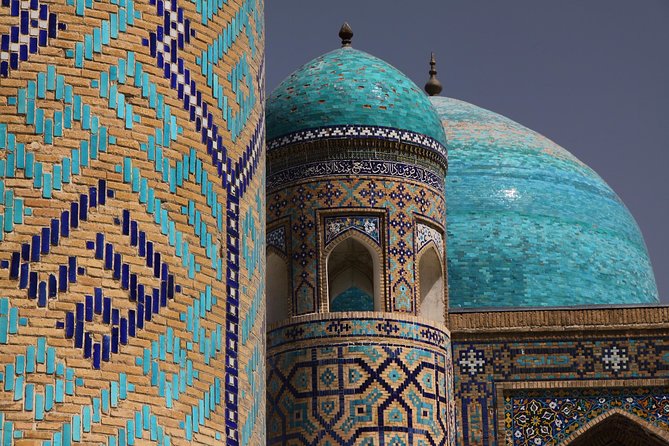
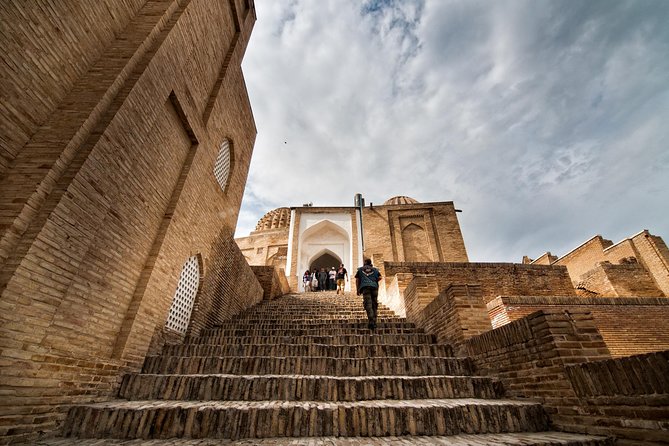
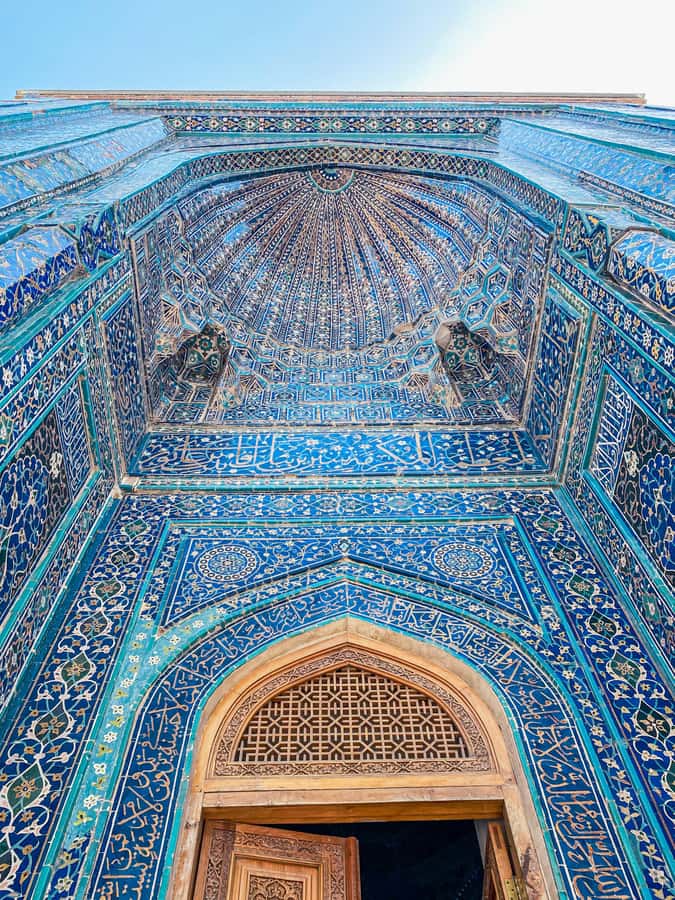
Shahi-Zinda is likely to be the most intimate stop on the itinerary. This UNESCO World Heritage site is formed by a series of mausoleums arranged along narrow alleyways. Instead of one enormous façade, you move through a sequence of tombs, doorways, and tiled surfaces.
I like this part of the route because it asks you to slow down. The decoration changes as you walk, and the tight passage gives the complex a more personal scale than Registan or Bibi-Khanym. Each mausoleum has its own story, and your guide can explain how the site reflects Samarkand’s religious and dynastic past.
The tilework is the main event. Look closely at the geometric patterns, lettering, and shifts in color. The surface decoration is not just a background for photographs. It carries meaning, marks status, and shows the level of craft invested in the city’s sacred buildings.
The narrow walkways also bring practical considerations. This is not a wide, flat plaza, and the tour is specifically not suitable for wheelchair users. You should be comfortable walking through a historic complex and standing for explanations. The available information does not give a precise walking distance, so ask the provider if mobility is a concern.
Shahi-Zinda can also be one of the busiest-feeling parts of a city tour, though no fixed crowd level is promised. A small group helps, but you may still need patience when moving through the alleys. I would keep your camera away for part of the stop and let the guide point out details you might otherwise pass without noticing.
A few more Samarkand days to weigh up
- Samarkand: Historical Monuments Guided Walking Tour
★ 4.8 · 446 reviews - Small group: Tajikistan Seven Lakes Day trip from Samarkand
★ 4.8 · 299 reviews - Day Trip to the Seven Lakes of Tajikistan: From Samarkand
★ 4.7 · 133 reviews - Bukhara: Historical City Highlights Guided Walking Tour
★ 4.6 · 102 reviews
Gur-Emir, Timur’s final resting place
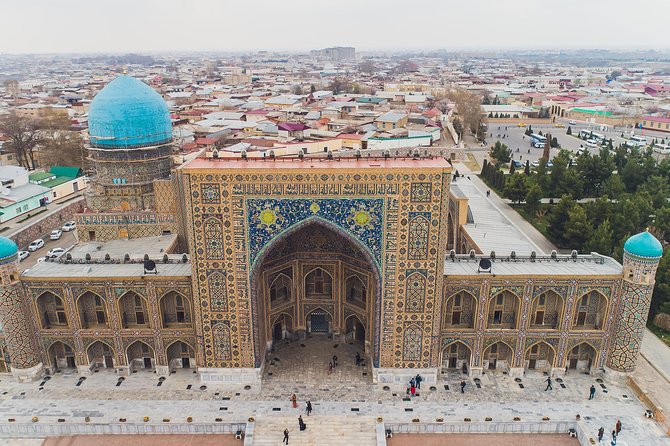
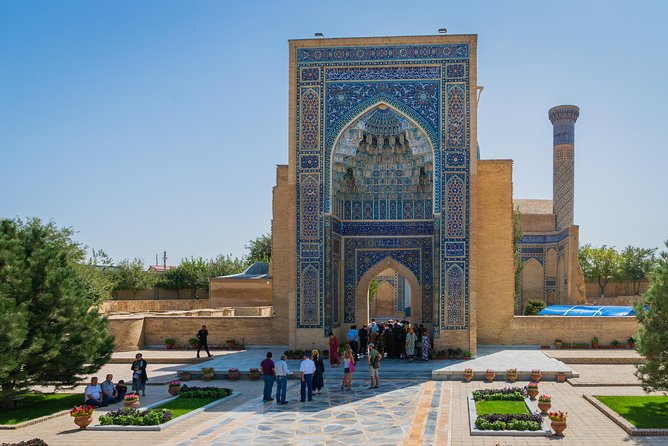
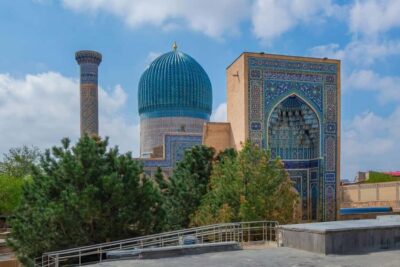
The final major stop is Gur-Emir Mausoleum, the resting place of Timur and his descendants. It is a fitting close to the route because Timur’s name connects several of the city’s grandest monuments.
Inside, the decoration turns the focus inward. Exquisite tilework and the large dome create a more concentrated experience than the open sweep of Registan Square. Your guide can explain who is buried here and why the mausoleum matters to Samarkand’s story.
The building’s influence also gives the stop wider importance. Its dome and design have inspired later architecture, so Gur-Emir is not simply a tomb to check off a list. It helps you see how Samarkand’s style traveled beyond the city.
I would listen for the family connections here. Without guidance, it is easy to remember only Timur’s name and miss the larger dynastic picture. An expert explanation can turn the mausoleum from a beautiful interior into a place with a clear role in the city’s past.
The itinerary concludes at Registan Square. That is practical, since you can stay in the historic center afterward, take more photographs, or simply sit and absorb the view. The tour does not include meals, so plan food separately rather than expecting a restaurant stop to be built into the schedule.
What the guides add to the experience
The guide is the main reason to book this rather than visit the monuments alone. The tour promises English and Russian, and the available guide names include Amin and Umid. The exact person assigned may vary, so confirm your language and guide details when booking.
Amin is described as bringing wit to the tour. That matters in Samarkand, where you can easily hear a long list of dates without seeing how the pieces connect. Humor, used well, keeps the information moving and gives you a more relaxed way into the city’s past.
Umid is noted for being at the station and quickly arranging a driver. That points to a useful strength: practical help, not only formal commentary. If you are arriving by train, ask in advance about the meeting point and pickup arrangements, since a smooth start saves time.
The strongest praise centers on information, kindness, help, and organization. Those qualities are worth more than a guide who simply recites names. You want someone who can explain why a monument matters, answer a question without rushing, and keep the group moving through a full sightseeing route.
Because this is a small-group experience, you should have more opportunity to ask about architecture, local customs, or Samarkand’s role in trade and scholarship. It is not a private tour, so you will still share the guide’s attention with others. For many people, that is the right middle ground between a large bus tour and a costly one-to-one guide.
Timing, transport, and the real cost
The route covers four major landmarks, and one account of the sightseeing portion describes visiting three historical sites in three and a half hours. That gives you a sense of the brisk pace possible in Samarkand, though the exact timing may depend on entrance procedures, traffic, group size, and how much time you spend at each monument.
Transportation to all included landmarks is part of the price. This is a real benefit because the sights are not all one single room-sized complex. You can save your energy for the monuments instead of negotiating every transfer yourself.
Entrance tickets are not included. This is the key budget point. At $85 per person, you are paying for the guide, transport, and small-group structure, then adding admission fees and food. I would book it for convenience and interpretation, not because it is the cheapest way to see the exteriors.
You can reserve now and pay later, which helps if your Uzbekistan plans are still shifting. Cancellation is allowed up to 24 hours in advance for a full refund. Those terms make the booking less risky, but you should still check the final meeting and payment details before committing.
Alcohol, drugs, explosive substances, and pets are not allowed. The tour is not suitable for babies under one year or people over 95, and it is not designed for wheelchair users. These restrictions are simple, but they matter when you are choosing a route through historic sites with uneven or narrow areas.
Who should book this Samarkand tour
I would recommend it to a first-time Samarkand visitor who wants the major monuments explained in one organized outing. It is also a good fit if you are arriving by train, have limited time, or prefer not to arrange drivers between each landmark.
You will get the most from it if you enjoy architecture, dynastic history, religious buildings, and Silk Road stories. The guide’s role is not just to point at blue tiles. It is to show how scholarship, empire, faith, and trade shaped the city.
Independent visitors may prefer to buy their own tickets and set their own pace. If you want to linger at one mausoleum, return to Registan at a particular hour, or stop for a meal whenever you please, a guided route will feel more fixed. The tour ends at Registan, though, so you retain some freedom afterward.
Families with very young children should look elsewhere because babies under one year are not accepted. Anyone using a wheelchair should also choose a different arrangement. For other visitors who can manage the walking and standing, the small group and included transport make the day easier.
Should you book it?
Book this Samarkand city tour if you want the essential monuments in one well-supported route and care about the stories behind the architecture. The strongest reasons are the small group, transport between sights, and guides such as Amin or Umid who can add personality and practical help.
Think twice if $85 feels high before entrance fees and meals. A self-guided visit may cost less, but you will need to arrange transport and supply your own context. For a first look at Samarkand, I think the guided option earns its price when your time is short and you want the city to make sense, not just look beautiful.
FAQ
How much does the Samarkand city tour cost?
The tour costs $85 per person. Entrance tickets to attractions and meals are not included.
Which landmarks are included?
The route includes Registan Square, Bibi-Khanym Mosque, the Shahi-Zinda complex, and the Gur-Emir Mausoleum.
What will I see at Registan Square?
You will see the Ulugh Beg Madrasah, Sher-Dor Madrasah, and Tilya-Kori Madrasah, with explanations about their construction and the scholars connected with them.
Is transportation included?
Yes. Transportation to all included landmarks is provided.
What languages are available?
The tour is available in English and Russian.
Is this a small-group tour?
Yes. It is designed as an intimate small-group experience for more personal attention from the guide.
Are entrance tickets included?
No. You need to pay attraction entrance fees separately.
Can I cancel for a full refund?
Yes. You can cancel up to 24 hours in advance for a full refund.
Is the tour suitable for wheelchair users or babies?
No. The tour is not suitable for wheelchair users or babies under one year. It is also not suitable for people over 95 years old.
Just added around Samarkand
- Bird Watching Tours in Samarkand★ 3.6 · 3 reviews
- Seven Lakes Panjakent: One-Day Adventure from Samarkand★ 5.0 · 3 reviews
- Ancient and Modern tour in Samarkand with Transport★ 5.0 · 3 reviews
- From Samarkand: 2-Day Yurt Camp Adventure with Camel Ride★ 4.7 · 3 reviews
- Samarkand: Cooking class with local family★ 5.0 · 3 reviews
- Explore Samarkand Guided Tour with Transfers★ 5.0 · 3 reviews
- Penjikent Day Trip From Samarkand★ 5.0 · 3 reviews
- Amankutan Trek One Day Tour From Samarkand★ 3.9 · 3 reviews
City Tours in Samarkand, compared.
Samarkand: Historical City Highlights Guided Walking Tour
Read our review →
Private Samarkand City Tour With Transportation
Read our review →
A City Tour Of Samarkand: The Pearl Of The East
Read our review →Samarkand: Private Tour of Ancient City and Traditional Art
Read our review →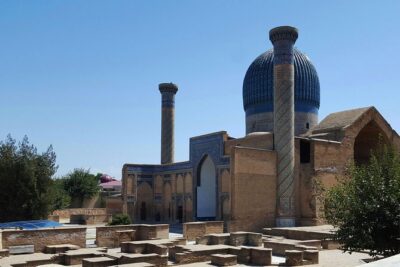
Private Guided Tour Samarkand city history and culture
Read our review →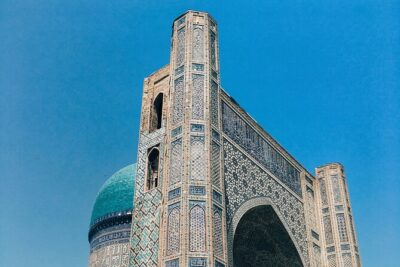
Samarkand City Tour with a Professional Photographer
Read our review →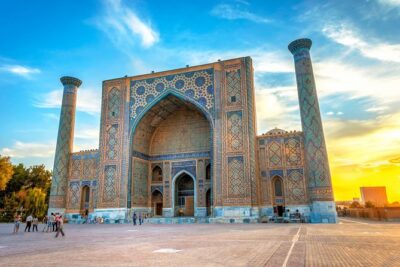
Browse the lists this tour appears in