
Reviewed · TASHKENT TOURS
Uzbekistan 6 days private tour Tas-Khiva-Buk-Sam-Tas
Uzbekistan’s great Silk Road cities are spread across a huge stretch of Central Asia, but this six-day private tour links Khiva, Bukhara, Samarkand, and Tashkent without asking you to arrange every flight, train, hotel, and transfer yourself. You get ancient mosques and mausoleums, tiled courtyards, lively markets, and a useful look at modern Tashkent in one tightly packed trip.
I like the private format, which gives you a chance to adjust the route toward food, architecture, or history. I also like the practical setup: centrally located three-star or boutique hotels, five breakfasts, local guides in each city, air-conditioned vehicles, train tickets, and entrance fees are bundled into the $850 price.
The catch is pace. You spend long stretches moving between cities, and the tour depends on transport schedules and ticket availability. The Tashkent to Urgench flight is not included, and fast train seats can sell out well before departure.
Key points to know before booking
- Four major cities in six days: You see the main historic centers of Uzbekistan, but this is a highlights trip rather than a slow exploration.
- Private guides in each city: Amir or Umid coordinates the arrangements, while local guides lead sightseeing in each destination.
- Transport is mostly handled: The package includes trains, city transfers, and vehicles, but the Tashkent to Urgench flight costs extra.
- Khiva is the visual high point: Itchan Kala, with its walls, minarets, mosques, and palaces, gives you a compact old city that is easy to explore on foot.
- Train timing matters: The Khiva to Bukhara journey takes about six hours, and the Samarkand to Tashkent train may be a regular service if faster seats are gone.
- Good value for a private route: Hotels, breakfasts, site tickets, guides, and much of the transport are included, reducing the usual planning work.
What the $850 price really covers
At $850 per person, this is not a budget backpacking trip, but it covers a great deal for a private six-day route. You receive accommodation in twin rooms at centrally located, highly rated three-star or boutique hotels, five breakfasts, local licensed guides, air-conditioned transport, train tickets for the intercity route, and entrance tickets to museums and historic sites.
That bundle matters in Uzbekistan. The four cities are not close together, and the connections involve a domestic flight, long train rides, station transfers, and local driving. Having a coordinator arrange the handoffs can save time and prevent the sort of small transport problems that become large ones when you do not speak Russian or Uzbek.
You still need to budget for the Tashkent to Urgench flight, which is expressly excluded. Single rooms cost an additional $20 per room per night, and museums may charge $1 to $2 in cash for photo or video permission. Those extras are minor, but you should carry small cash for them.
The package uses twin rooms as its standard. If you are traveling alone, confirm the room arrangement and single supplement before paying. The tour also offers group discounts, though the exact discount is not stated.
A few more Tashkent days to weigh up
- From Tashkent: Uzbekistan Private 6-Day Tour
★ 5.0 · 6 reviews - Uzbekistan Tour – 6 Days 5 Nights
★ 5.0 · 4 reviews - Uzbekistan 6 Days Private Tour Khiva-Bukhara-Samarkand by Train
★ 5.0 · 4 reviews
Day 1 in Tashkent is mainly a soft landing
Your first day is deliberately light. You arrive in Tashkent, enjoy views of the city during the transfer, and go to your hotel. The listed transfer takes about 30 minutes, depending on traffic and your arrival point.
That may feel underwhelming if you have only six days, but it has a practical purpose. You get a hotel check-in and a chance to recover before the fast run through western Uzbekistan. Since the main Tashkent sightseeing is saved for the final day, you should not expect a full city tour at the beginning.
The tour offers pickup, and border pickup can be arranged on request. If you are arriving from another country or combining this trip with a neighboring destination, ask about the exact meeting point and transfer plan before you go.
Day 2 turns Khiva into an open-air museum
Day 2 begins with a flight from Tashkent to Urgench, taking about two hours. The airfare is not included, so this is the first major cost to add to the advertised price. From Urgench, you transfer to Khiva and enter Itchan Kala, the walled inner city.
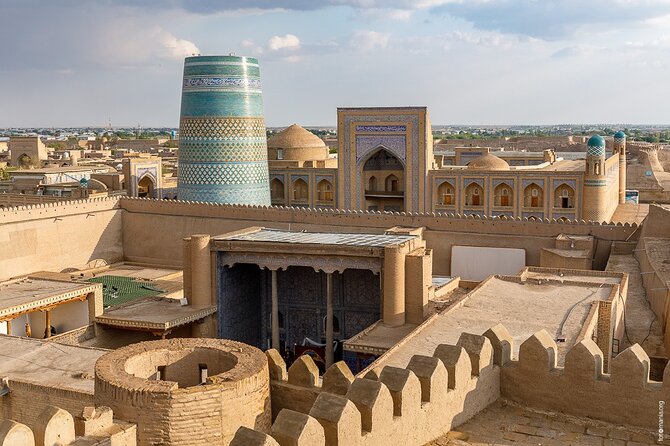
Itchan Kala is the reason Khiva feels so different from the other cities on this route. Its historic core covers about 26 hectares and has a history stretching back more than two thousand years. The old town is compact, and its close-set monuments make it possible to cover a lot without spending the day in a vehicle.
You begin with the Kunya Ark citadel, the former fortified center of Khiva’s ruling power. Allow about an hour. The citadel gives you useful context for the city because it was not just a palace. It was a working seat of government, defense, and royal life.
The Pahlavan Mahmud Mausoleum follows. Pahlavan Mahmud was a local poet, philosopher, wrestler, and healer, and his mausoleum is one of Khiva’s more personal sacred places. The visit takes about 40 minutes, enough time to study the decoration and hear the local stories surrounding him.
At the Juma Mosque, look upward and around rather than expecting a vast open prayer hall. The mosque is famous for its forest of wooden columns and its central position in Itchan Kala. The visit is short, about 20 minutes, but it is an important stop because Friday prayers once carried direct political meaning in the city.
The Islam Khoja complex brings together a madrasa and one of Khiva’s most recognizable minarets. The planned visit lasts about 40 minutes. If climbing the minaret is offered or available, ask your guide about the conditions, since the basic tour details do not promise a climb.
Tash Khauli Palace, built from 1830 to 1838 for Allakuli Khan, shows Khorezm court architecture at its most formal. Give it about 40 minutes. Its courtyards and tilework help explain how a palace could feel both ceremonial and private.
You finish with Kalta Minor, the bright, unfinished minaret near the western gate. Its glazed tile and majolica covering make it instantly recognizable. The fact that it was never completed is part of its appeal, and a 30-minute stop is enough for photographs and an explanation of its place in Khiva’s skyline.
Khiva is likely to be the easiest city on the route for a first visit. The main sights are close together, and your guide can help you move through the old city without losing time. The drawback is that Day 2 is full. After the flight, transfer, and many monument visits, you may want free time to simply wander the lanes.
Day 3 trades Khiva’s lanes for a six-hour ride
You have free time in Khiva before traveling to Bukhara. The transfer can be by train or car, and the journey takes about six hours either way. This is a long travel day, so do not plan an ambitious independent schedule around it.
The train offers a more relaxed way to watch Uzbekistan pass by, while a private car gives you greater flexibility for stops if the operator agrees in advance. The package says the itinerary can be adjusted at no or small extra cost, so this is a good moment to ask about a roadside stop or a different departure time.
You arrive in Bukhara with free time rather than a major guided sightseeing block. That is useful because Bukhara’s old center rewards an evening walk, but your available time will depend on the train or car schedule and how early you leave Khiva.
Same city, a completely different day out:
- Best of Tashkent Mountains: Amirsoy, Chimgan & Charvak Trip
★ 4.8 · 567 reviews - Samarkand One Day Tour – Departure From Tashkent
★ 5.0 · 313 reviews - Samarkand One-Day Tour Departure from Tashkent
★ 4.7 · 171 reviews - Tashkent: Amirsoy Resort, Chimgan Mountain and Charvak Lake
★ 4.8 · 170 reviews
Day 4 covers Bukhara before the train to Samarkand
Bukhara’s old center feels more spread out than Khiva, and Day 4 gives you a strong selection of its major sights. You begin at Lyab-i-Hauz, a square built around a historic pool and shaded by old trees. It has long served as one of Bukhara’s main gathering places and remains a natural place to pause.
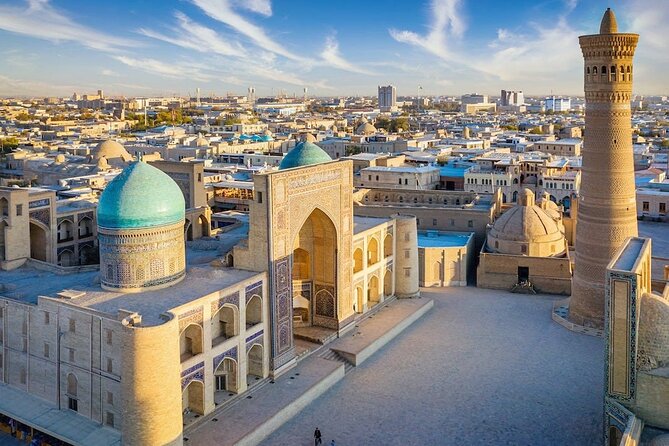
The Great Minaret of the Kalon is next. Built in 1127, it rises 45.6 meters and is one of the few surviving pieces of the early Kara-Khanid mosque complex. The minaret’s survival through conquest gives the site real force, but your guide can also help you understand its practical role as a landmark and call-to-prayer tower.
Bolo Hauz Mosque sits opposite the Ark Fortress. Its name means above the pool, and the mosque is known for its elegant wooden columns and connection to the water basin in front. The visit is brief, about 20 minutes, but it pairs well with the nearby fortress.
The Ark of Bukhara is the city’s old royal citadel, a fortified town within the town. Plan on about 90 minutes. You will see why Bukhara’s rulers needed more than a palace: the Ark housed the machinery of government, court life, and defense for centuries.
The schedule then becomes demanding. In the late afternoon, you transfer about 15 kilometers to the station in Kagan, board a train for Samarkand, and continue to your hotel after arrival. The train portion is listed at about three hours, but station transfers and boarding time add to the day.
If your priority is architecture, the Bukhara schedule works well. If you prefer long café stops, shopping, or unhurried photography, you may find it too compressed. Ask for the exact train time before departure, since availability affects the shape of this day.
Day 5 gives Samarkand its proper showcase
Samarkand receives the fullest sightseeing day, and that is sensible. The city’s major monuments are spread farther apart than Khiva’s, so the included vehicle and city guide are especially useful.
Begin at Gur Emir Mausoleum, the tomb of Timur, also known as Tamerlane. The building dates from 1404 to 1405 and is the final resting place of one of Central Asia’s most powerful rulers. The blue and gold interior is memorable, but the larger point is the way the mausoleum connects political power, dynastic memory, and architecture.
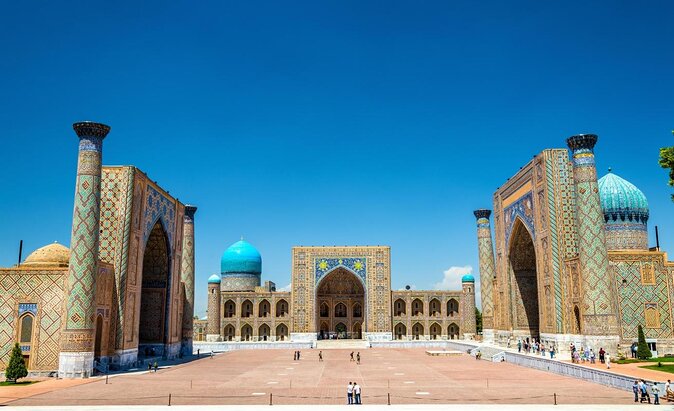
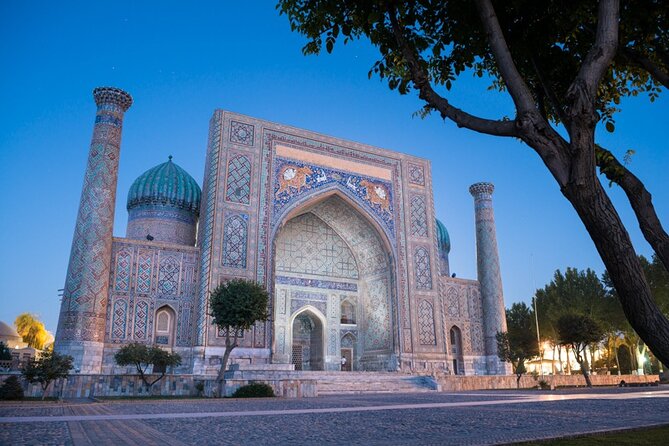
Then comes Registan, Samarkand’s great ceremonial square. Three madrasas frame the space: Ulugh Beg, Sherdor, and Tilla-Kari. You get about 90 minutes here, which is enough to enter the buildings and appreciate the changing tile patterns, but you may wish you had even longer.
Bibi Khanym Mosque was built between 1399 and 1404 on Timur’s order and named for his wife. Its huge scale reflects imperial ambition, though the building’s history also includes reconstruction. The planned 30-minute visit gives you the main view without slowing the rest of the day.
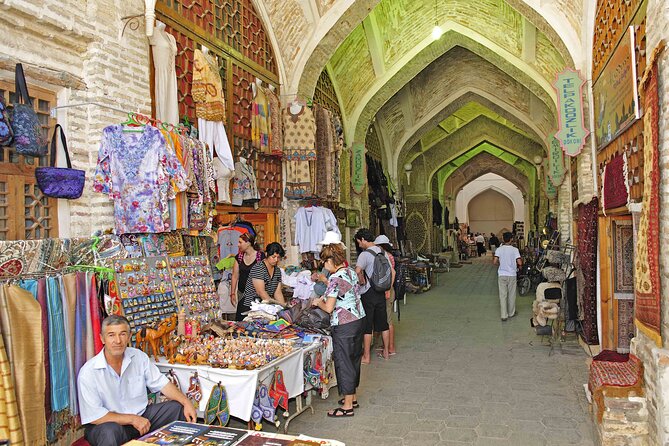
Siab Bazaar adds a needed everyday note. After several grand monuments, you can see produce, food, and handicrafts in a working market. The stop lasts about 40 minutes, so use it to buy something local or watch the daily rhythm rather than treating it as another monument.
Shah-i-Zinda is the emotional high point for many visitors. The ensemble contains 44 tombs arranged through more than 20 mausoleums on the southeastern side of ancient Afrosiab. Its narrow passage and repeated blue tile designs reward a slower pace, but the itinerary allows about an hour.
You finish at Ulugh Beg Observatory, where only the foundations remain. Ulugh Beg, Timur’s grandson, was an astronomer, scientist, and architect. The site matters because it shows Samarkand as a center of science as well as royal display.
This is a very full day. I would ask your guide to protect enough time at Registan and Shah-i-Zinda, even if that means shortening a less important stop. The private setup makes such adjustments possible.
Day 6 brings you back to Tashkent
The final day starts early with a transfer to Samarkand station and a train to Tashkent. The fast service is subject to availability. Fast tickets can sell out around 60 days before departure, and a regular train may be used instead, which can make the morning longer than expected.
Once in Tashkent, you meet your guide and driver for a three-hour city tour. The city is a different experience from the old Silk Road centers. It is modern, broad, and shaped by both Soviet planning and Uzbek independence.
The Alisher Navoi Theater, designed by Alexey Shchusev and built from 1942 to 1947, is a quick architectural stop. It opened in connection with the 500th anniversary of Alisher Navoi’s birth. The listed visit is about 20 minutes.
The Hazrati Imam complex provides the main religious stop. The square includes the Tillya Sheikh Mosque and other important buildings in Tashkent’s old city. Allow 90 minutes, and dress respectfully for the mosque and sacred spaces.
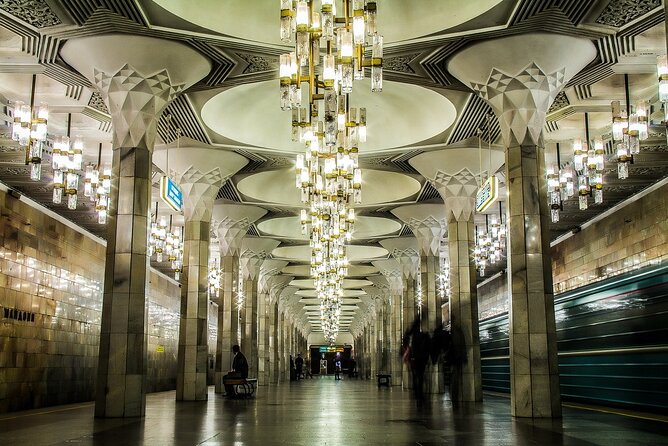
The Tashkent Metro gives you an efficient look at the city’s public architecture. Opened in 1977 as the first underground system in Central Asia, its stations use marble, granite, columns, bas-reliefs, and decorative plasterwork. One hour is enough for a short ride and a look at several stations.
Amir Temur Square offers a pause in a green central setting, with fountains, flowers, and a statue of Timur on horseback. The State Museum of History of Uzbekistan is also listed for an hour, but confirm its current opening status before the tour. The itinerary has previously needed to substitute another museum when listed sites were closed, and you should expect your operator to explain any change clearly.
At the end of the day, you transfer to Tashkent International Airport. Because the departure transfer follows a full morning of sightseeing, give yourself a comfortable margin before your outbound flight.
Why the private guide system matters
The tour uses a guide in each city rather than one person accompanying you for every mile. That arrangement makes sense in Uzbekistan because each city has its own local story and the logistics change often.
Amir and Umid are named as coordinators who help organize the trip. The available feedback places high value on fast communication, punctual drivers, and guides from different generations who offer different views of the country. I would confirm the names of your city guides and the daily meeting times before arrival.
The private format also helps with small choices. You can request changes based on food, architecture, or history, and some travelers have added a traditional yurt night and extra stops at an old fortress and caravanserai. Those additions are not part of the standard route, but they show what can be discussed before booking.
Who should book this six-day route
I would recommend it to a first-time visitor who wants the country’s four headline cities and prefers help with transport. It also suits solo visitors and families, since the private vehicle, station pickups, and city guides reduce the strain of navigating an unfamiliar country.
It is a good fit if you want structure but do not want a fixed group. You can ask for changes, and only your own party participates.
I would hesitate if you want long mornings, slow meals, or several free days in each city. Six days is enough to see the essential monuments, but not enough to know every neighborhood. The six-hour Khiva to Bukhara transfer and early Samarkand to Tashkent departure are the price of covering so much ground.
The tour has a 4.9 rating from 45 reviews and a 98 percent recommendation rate, with especially strong praise for organization, guide quality, friendly drivers, and quick help from Amir and Umid. One recurring caution is worth taking seriously: transport can change, and outdated sightseeing information can occasionally remain in a schedule. Ask for the final plan close to departure.
Should you book the Uzbekistan Silk Road tour?
Book it if your goal is to see Khiva, Bukhara, Samarkand, and Tashkent in six days with hotels, guides, train travel, vehicles, breakfasts, and site tickets arranged. At $850 per person, it offers solid value for a private trip, especially for solo visitors or small parties that would otherwise pay separately for every transfer.
Before booking, price the Tashkent to Urgench flight, check your visa needs, confirm room arrangements, and ask which train services are secured. If you accept the brisk pace and build in patience for schedule changes, this is a practical way to get your first, memorable look at Uzbekistan.
FAQ
How long is the Uzbekistan private tour?
The tour lasts approximately six days, beginning in Tashkent and ending with a transfer to Tashkent International Airport.
Which cities are included?
The route includes Tashkent, Khiva, Bukhara, and Samarkand.
Is the tour private?
Yes. Only your group participates in the tour.
Is the Tashkent to Urgench flight included?
No. The flight ticket from Tashkent to Urgench is not included in the tour price.
What transport is included?
The package includes an air-conditioned vehicle and train tickets for the Khiva to Bukhara, Bukhara to Samarkand, and Samarkand to Tashkent portions of the route. The Tashkent to Urgench flight is separate.
Are hotels included?
Yes. Accommodation in twin rooms at centrally located, highly rated three-star or boutique hotels is included.
Are meals included?
Five breakfasts are included. Other meals are not listed as included.
Are entrance tickets included?
Yes. Entrance tickets to the listed museums and historic sites are included. Photo and video museum charges of about $1 to $2 per museum must be paid in cash.
Can the itinerary be customized?
Yes. The itinerary can be changed to suit your interests in cuisine, history, or architecture, usually at no or small extra cost. Requested changes should be discussed before departure.
What happens if I need to cancel?
You can receive a full refund if you cancel at least 24 hours before the experience start time. Cancellations or changes made less than 24 hours before the start time are not accepted for a refund.
Just added around Tashkent
- Tashkent Mountain Tour Amirsoy with Transport★ 3.5 · 3 reviews
- Tashkent: 3-Day Horseback Riding Tour in Chimgan Mountains★ 4.4 · 3 reviews
- Private Intercity Transfer Tashkent – Samarkand – Tashkent★ 3.5 · 3 reviews
- Samarkand: Uloq-Kopkari (Buzkashi) Game Day Tour★ 5.0 · 3 reviews
- Private Tashkent City Tour★ 5.0 · 3 reviews
- Transfer Tashkent Airport / Railway Station – Hotel★ 3.5 · 3 reviews
- Half-day excursion around Tashkent★ 5.0 · 3 reviews
- Amirsoy & Chimgan mountain tour from Tashkent★ 5.0 · 3 reviews
Tashkent Tours, compared.
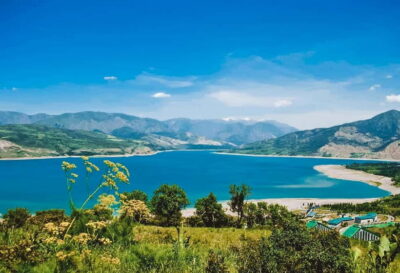
Best of Tashkent Mountains: Amirsoy, Chimgan & Charvak Trip
Read our review →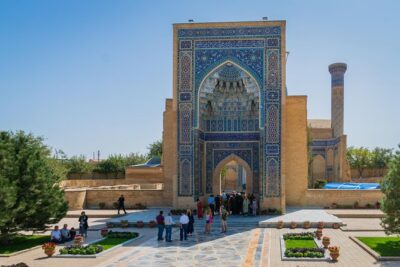
Samarkand One Day Tour – Departure From Tashkent
Read our review →Tashkent: Amirsoy Resort, Chimgan Mountain and Charvak Lake
Read our review →From Tashkent: Sightseeing Day Trip to Khujand, Tajikistan
Read our review →Explore Amirsoy, Chimgan & Charvak – A Full-Day Mountain Tour
Read our review →Tajikistan : Exclusive Seven Lakes Day Tour From Samarkand
Read our review →Explore Amirsoy, Chimgan, Charvak Adventure Tour
Read our review →
Browse the lists this tour appears in